
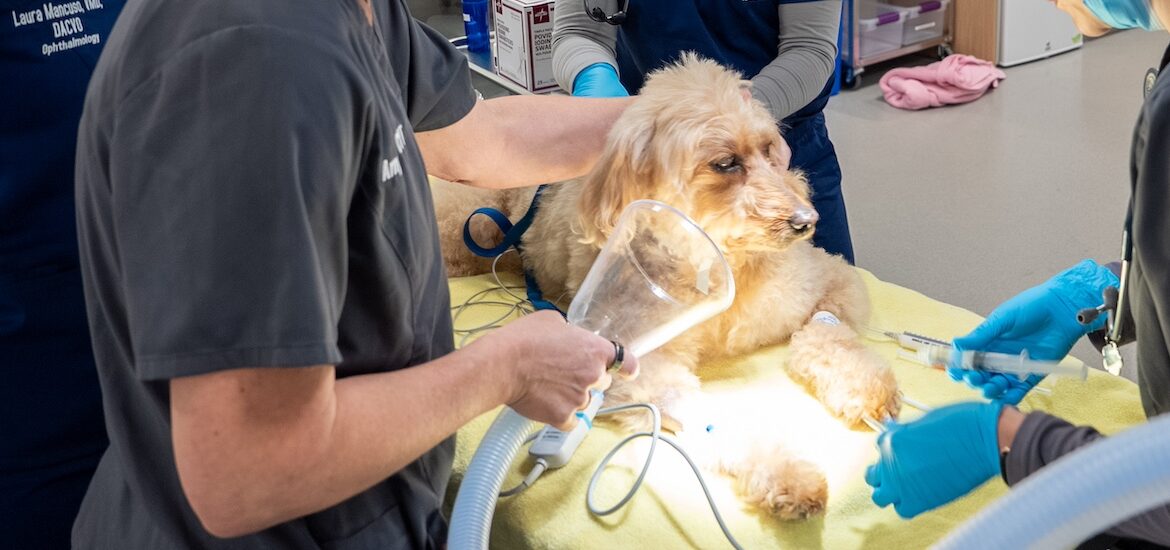
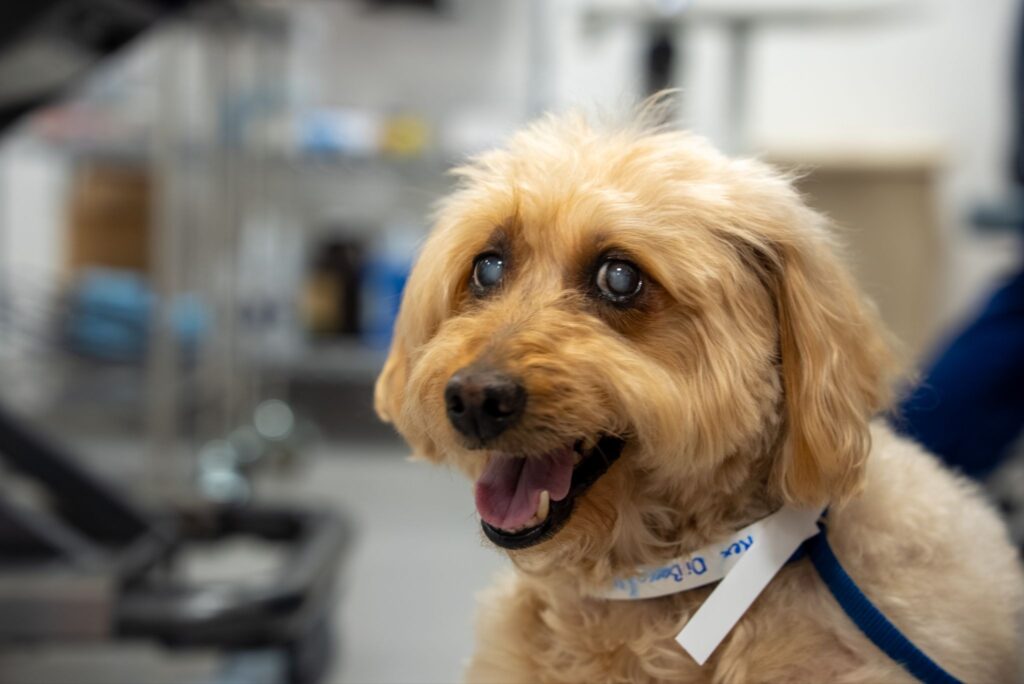
For 11-year-old goldendoodle Rex, losing his vision happened quickly.
“One day he could see and the next day he was bumping into walls and couldn’t figure out how to go down the steps,” his owner Jessica DiBacco remembers.
Rex had developed cataracts in both eyes after becoming diabetic, leaving him nearly blind. Before long, the dog who once explored his home and yard had learned to stick to a few familiar places where he felt safe.
His world was getting smaller.
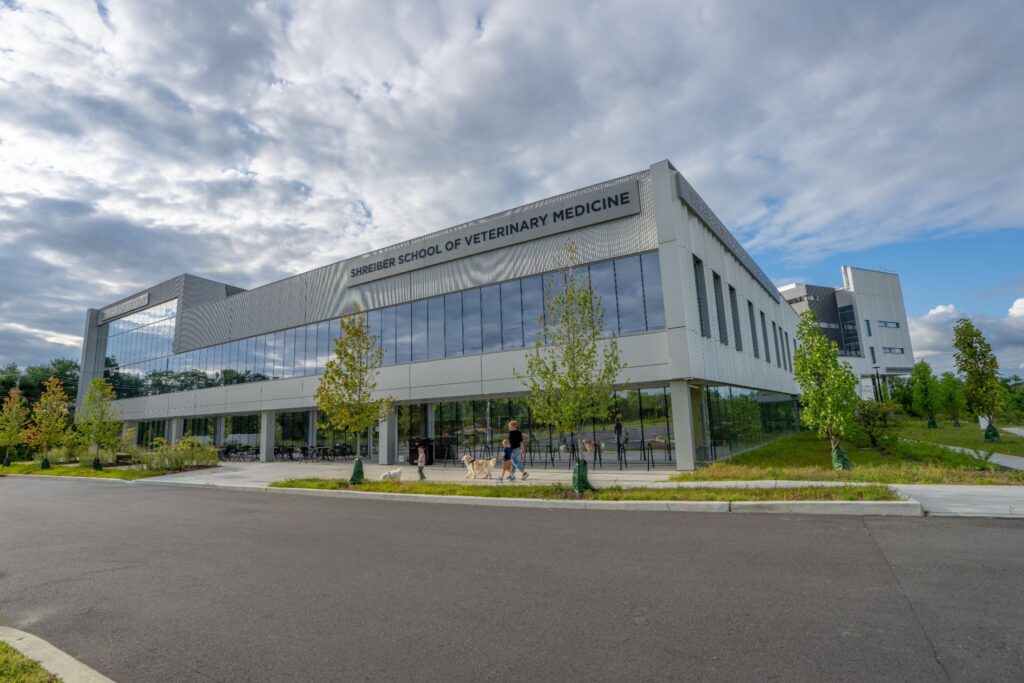
Then his family learned there might be a way to restore Rex’s quality of life, through Rowan University’s Shreiber School of Veterinary Medicine.
How Diabetes Led to Rex’s Cataracts
Rex’s journey began years before he lost his sight.
After developing a severe case of pancreatitis, Rex underwent emergency surgery to remove part of his pancreas. This led to him later developing diabetes, which eventually led to cataracts in both eyes.
As his eyesight disappeared, Rex adapted.
At home, he mostly stayed in the family room and kitchen. Outside, he learned one familiar route from the back door into the yard.
“Leading up to the [cataract] surgery, he was pretty much 95% blind,” says his owner Lou DiBacco, a Rowan University alumnus who earned a bachelor’s degree in finance in 2010 and his MBA in 2013.
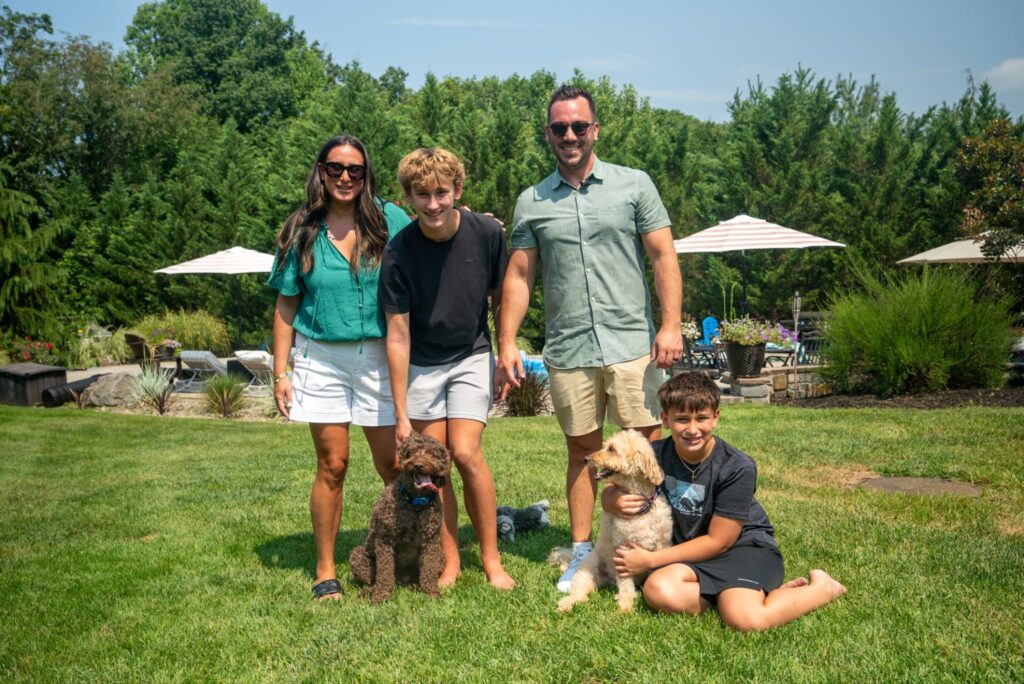
Even Rocco, the family’s younger dog, noticed the difference. When Rex became confused outside, Rocco would run over, nudge him and help guide him back toward the house.
The family wanted to help, but with Rex now 11 years old and managing other health concerns, they also had to decide whether putting him through surgery was the right choice.
Finding Veterinary Ophthalmology Care at Rowan
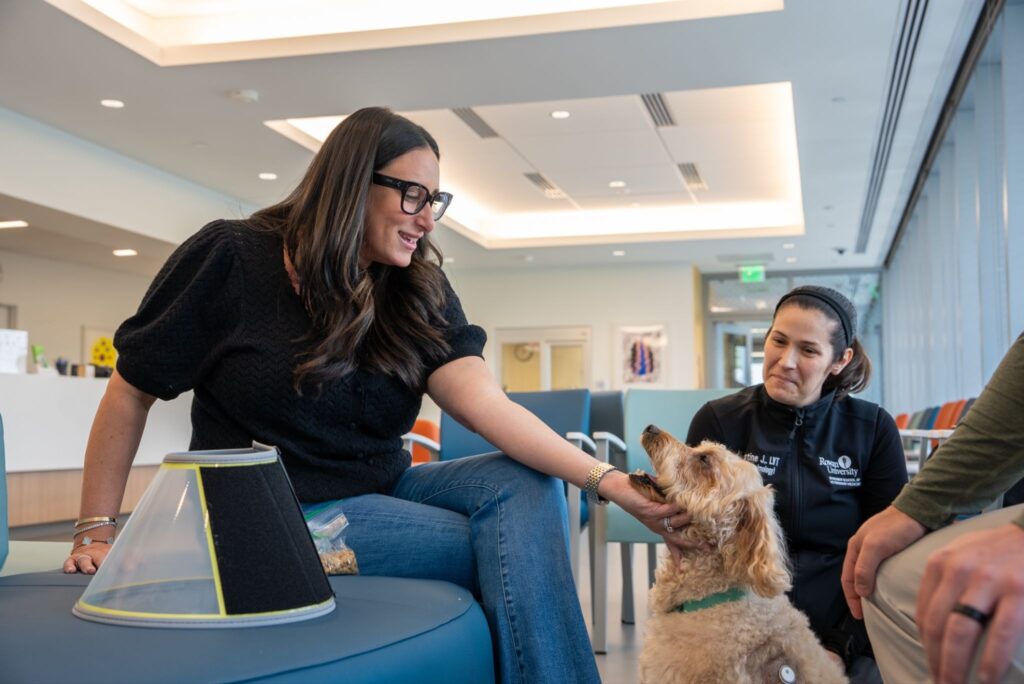
Rex’s family was referred to Rowan University’s Shreiber School of Veterinary Medicine, where they met veterinary ophthalmologist Dr. Laura Mancuso.
Testing showed that Rex’s retinas were functioning normally, making him a candidate for cataract surgery.
“This was his chance and his shot to get vision back,” Dr. Mancuso says.
For Lou, the trip to Rowan also felt a little familiar. As a Rowan student, and later alumnus, he witnessed the University’s expansion over the years. Now, he was returning for a reason he never could have anticipated.
“We’re really excited today to let our dog see us again,” he said before Rex’s procedure.
Inside Rex’s Cataract Surgery
Restoring Rex’s vision required more than one veterinarian in an operating room.
Dr. Mancuso worked alongside veterinary technicians and other members of the hospital team throughout the procedure. Because Rex is diabetic and had previously undergone pancreatic surgery, his team also closely monitored him while he was under anesthesia.
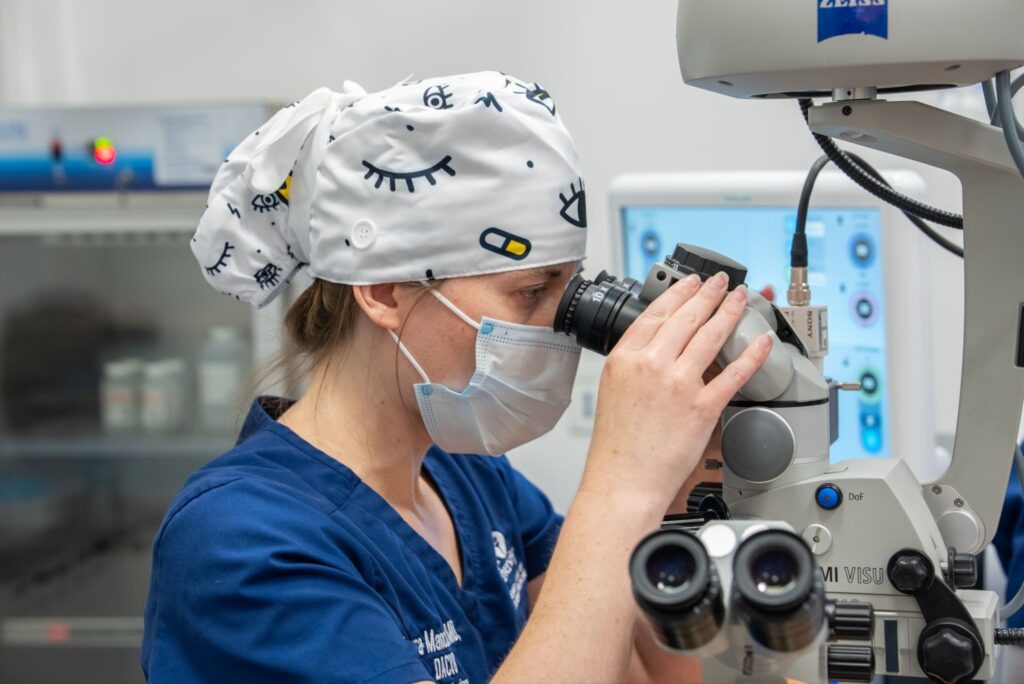
“I would not have been able to make this dog see again without my crew,” she says.
The procedure also became a learning opportunity for Rowan veterinary students, who were able to observe the surgery in real time. Watching the veterinary team work together gave students a firsthand look at the many moving parts of a surgical case, from patient monitoring and anesthesia to surgical technique and communication among members of the veterinary team. It was an opportunity to see classroom concepts come to life in a real patient care setting.
Then came the moment everyone was waiting for.
Rex woke up.
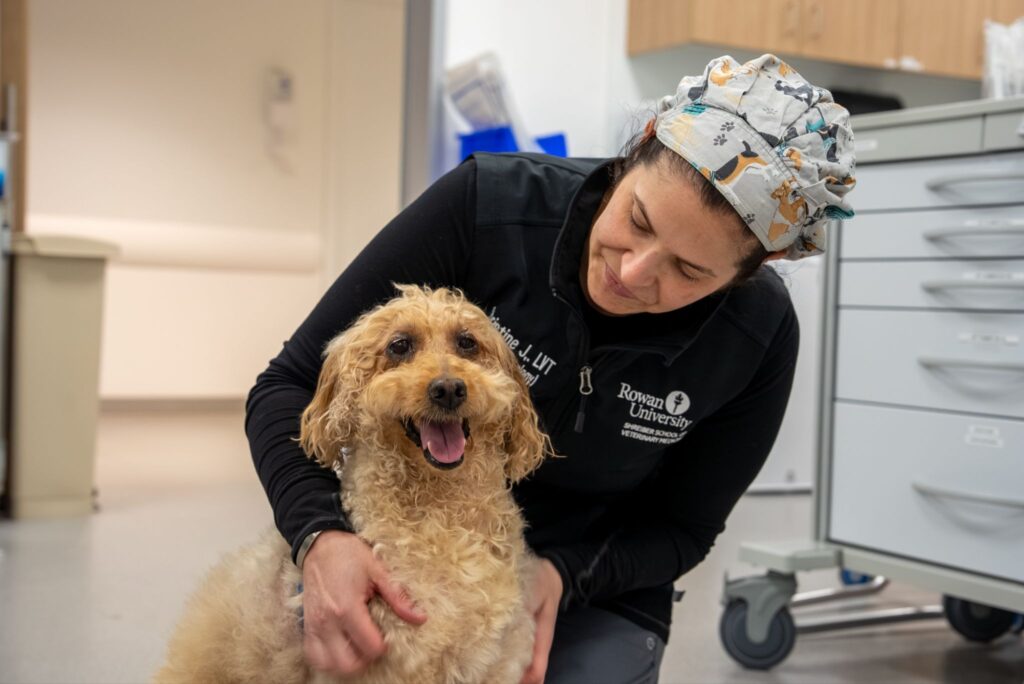
Since Rex was blind when he met Dr. Mancuso and much of the team who operated on him, he knew them by their voices, scents and touch.
He had never actually seen them.
“He woke up and he looked at every single person in the room,” Dr. Mancuso recalls.
A short time later, the team took Rex outside.
Dr. Mancuso reflects, “He was looking at the sky. He was looking at the traffic,”
Rex could see again.
Back to His Favorite Window
The difference became even more apparent when Rex went home.
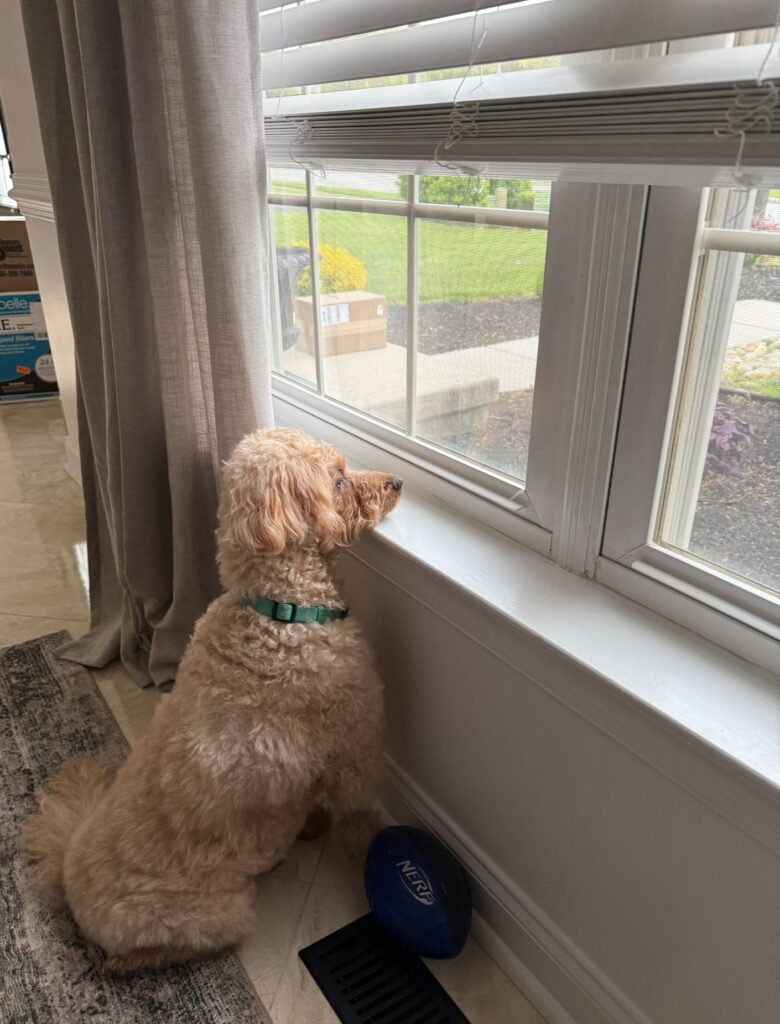
Before losing his vision, one of Rex’s favorite places was a large window in the family’s dining room. As his eyesight disappeared, he stopped visiting it. For three or four months, he hadn’t even gone into the room.
Within five minutes of returning home after surgery, Rex went straight back to his window.
He barked.
He watched the birds.
He watched cars drive by.
“It was really, really remarkable,” Jess says.
And that was just the beginning.
Three Months Later: Rex Is Exploring Again
Three months after surgery, Rex is doing things his family hadn’t seen him do in months.
He explores the yard. He moves throughout the house. He watches the world through his favorite window. He rides in the car with his head out the window.
And Rocco no longer needs to guide him around.
Instead, the two dogs are back to playing, stealing toys from each other and acting like best friends.
“Now he’s back to exploring and being a little mischievous,” Lou says. “He’s back to his normal self.”
For Jess and Lou, that change goes far beyond Rex simply being able to see.
His quality of life changed.
So did theirs.
“They adore him and have given him such good care,” Jess says of the team at Rowan. “I couldn’t thank them enough. They really changed his life, changed our life.”
Defying What Blindness Meant for Rex
Veterinary medicine doesn’t guarantee a victory every day.
That’s part of what makes cases like Rex’s so meaningful to Dr. Mancuso.
Cataract surgery, she says, is one of her favorite procedures because patients can enter the operating room unable to see and leave with a completely different experience of the world around them.
For Rex, that meant getting back much more than his eyesight.
It meant his yard.
His favorite window.
His best friend.
His family.
And the freedom to explore all of it again.
Sometimes Defying Definition means taking a smart risk when the outcome isn’t guaranteed.
For Rex and his family, it meant taking a chance on seeing what could come next.
About Schreiber School of Veterinary Medicine
The Shreiber School of Veterinary Medicine is shaping the future of veterinary medicine and animal healthcare in keeping with Rowan University’s strategic pillars of Access, Affordability, Quality, and Economic Engine. Our innovative curriculum, exceptional veterinary care, compassionate community service, and commitment to research will ensure our graduates will be prepared to serve society and meet the challenges in veterinary medicine now and in the future.
Our mission will be achieved by:
- Pioneering discovery of new knowledge in basic and applied sciences to address regional, national, and global concerns in human and animal health.
- Utilizing an innovative clinical curriculum that combines experiential learning in a university teaching hospital with clinical partnerships to ensure clinically competent and well-rounded veterinary graduates.
- Collaborating with partners in the Rowan community, industry, and government veterinary institutions to broaden the lens of education in veterinary medicine, preparing our graduates to serve society in a multitude of roles.
- Expanding the availability of veterinary care to underserved communities in the region and graduating compassionate and culturally aware veterinarians to be the leaders of tomorrow in community service and engagement.
About Rowan
The fastest-growing public research institution in the Northeast and among the country’s top 10 fastest-growing, Rowan University is home to a thriving multidisciplinary environment with a strong emphasis on practical research at the intersection of health care, engineering, science and business.
Carnegie-classified as an R2 (high research activity) institution and operating at R1 (very high research activity), the University partners with industry, government and nonprofit organizations in New Jersey and beyond to drive innovation, while developing the future workforce. Students are essential contributors, presenting at national conferences, sharing credit in professional publications and earning recognition for their work. Selected entrepreneurs receive support through the Rowan Innovation Venture Fund.
Rowan’s partnerships with Virtua Health, Cooper University Health Care and all major health care systems in southern New Jersey distinguish the region as a hub for health care research and education. Rowan is also a key partner with the New Jersey Economic Development Authority in two strategic innovation centers focused on medical technology.