
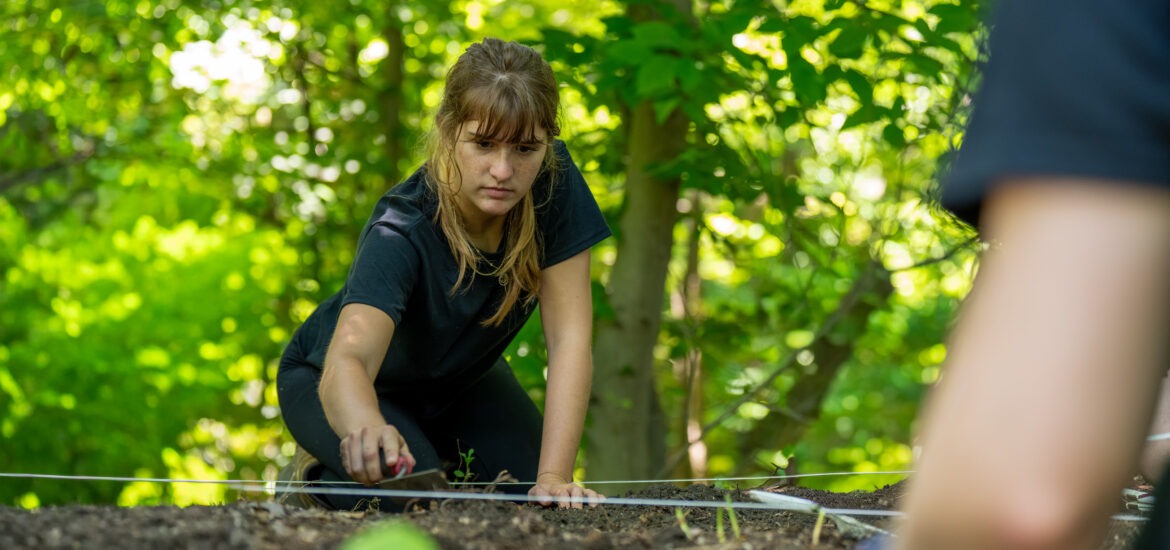
For Rowan University junior anthropology major Erin B., some of the most valuable lessons of the summer aren’t happening inside a classroom.
They’re buried in the dirt.
Behind the Edelman Fossil Park & Museum, Erin and other students in Rowan’s Anthropology Field School spent the summer excavating test pits, sifting soil and carefully documenting artifacts that offer clues to the people who once lived and worked in the area.
For Erin, that’s exactly the kind of learning she was looking for.
“I love hands-on experience, and I love to learn, and I love my major,” she said. “The field school for me became this open opportunity to go through and to learn and to have this hands-on experience.”
Getting Your Hands Dirty
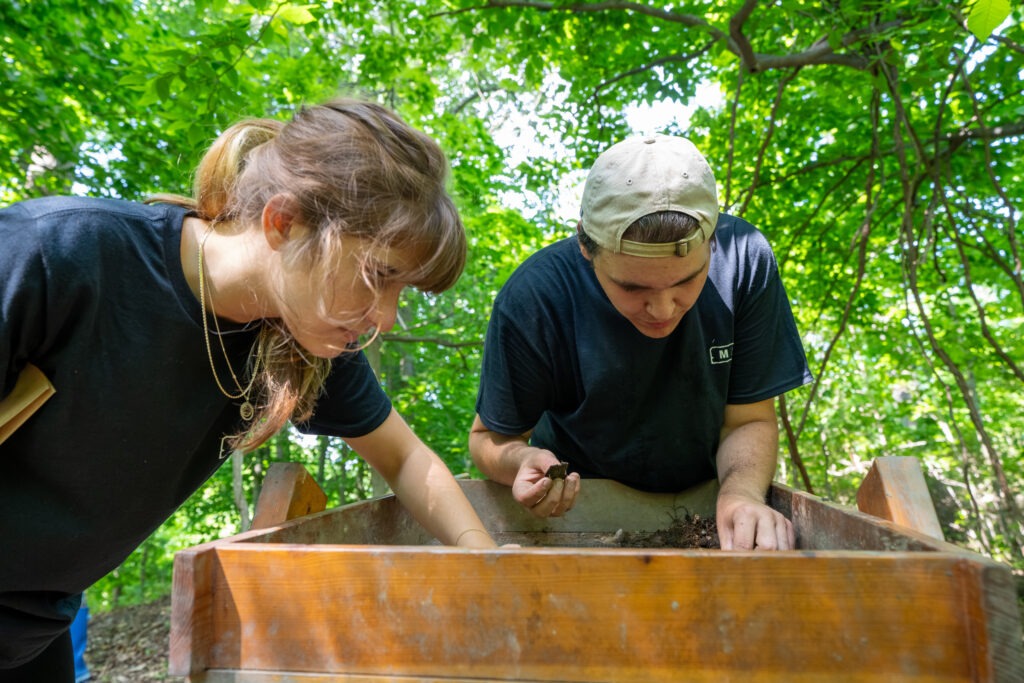
Field school takes archaeology out of the textbook and puts the tools directly into students’ hands.
Students aren’t simply looking for interesting objects. They’re learning the process professional archaeologists use to understand what those objects can tell us.
“The most important thing is making sure that we have it in context,” Erin said.
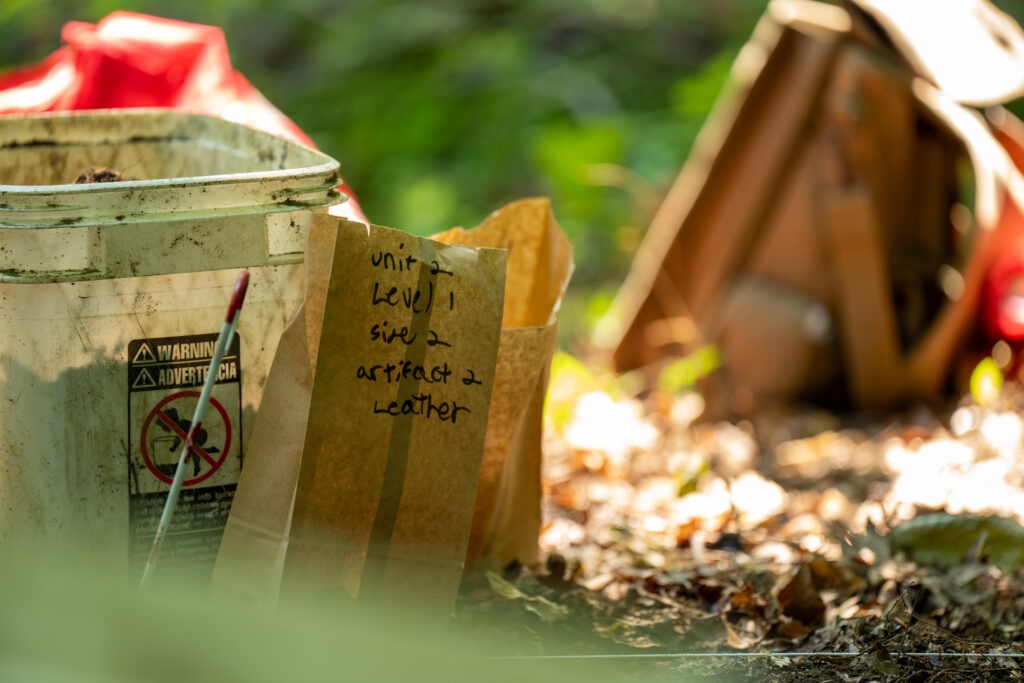
That means excavating layer by layer, recording exactly where an artifact is discovered, measuring its position, photographing it, bagging it and sifting the surrounding soil for pieces that could easily be missed.
A glass bottle by itself might not tell much of a story. Knowing exactly where that bottle came from changes things.
“For us, it’s, ‘Oh, this is a bottle found behind the Edelman Fossil Park. What does this mean?’” Erin said. “Being able to kind of piece that together allows for it to be figured out.”
Finding Stories Beneath the Surface
And there has been plenty to piece together.
Students have uncovered leather straps, pieces of shoes, porcelain and a variety of glass bottles, including Heinz ketchup bottles. Some still have labels. One contained remnants of paint. Others have roots growing through them.
There’s one discovery Erin particularly enjoys talking about: pieces of an almost complete toilet.
It’s funny at first. But even an object like that becomes another opportunity to understand the people and culture connected to the site.
“You learn the cultural context behind that,” she said. “All of the bottles as well—all of them are different and all of them have different backstories.”
The discoveries help students investigate what was happening around the area’s former mining camps and railroad operations, transforming objects left behind decades ago into evidence of everyday life.
Learning by Doing
Before field school, Erin had never done hands-on archaeological work.
That’s changed.
“I didn’t know anything about actual archaeological work, like hands-on work, until this school,” she said. “And now I can understand the process of things and I can explain the process of things and the importance of it.”
The experience doesn’t end when students leave the excavation site. Artifacts are brought back to Rowan, where students clean, photograph, research and attempt to date them before the objects are returned to the Fossil Park.
It’s an opportunity to experience more of the archaeological process instead of simply reading about how it’s done.
And sometimes that process requires patience.
A lot of it.
Erin has learned that archaeology isn’t an endless series of exciting discoveries. There’s measuring. Documentation. Sifting. And sometimes an entire bucket appears to contain nothing but leaves.
You sift it anyway.
“What if there’s something in there?” she said.
That repetition has taught Erin something beyond archaeology: to be patient with herself, with others and with the process.
More Than the Experience She Came For
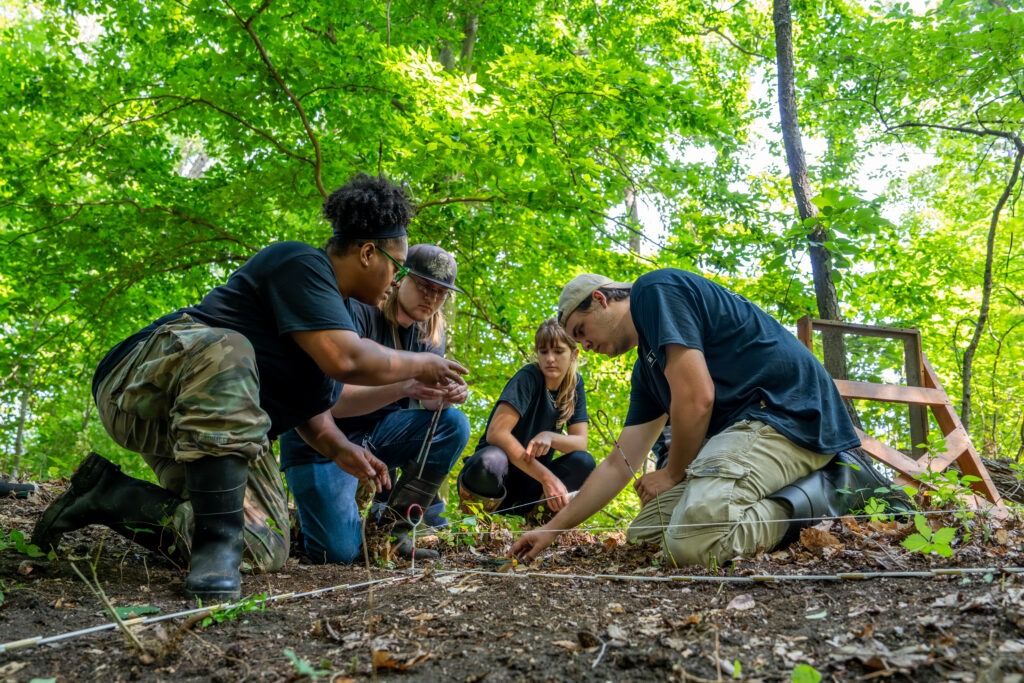
Field school has also given Erin the chance to learn alongside faculty members and classmates while everyone gets their hands dirty.
She said Professor Cushman created an environment where students could ask questions and learn without being embarrassed by what they didn’t know.
“This is everyone’s first time,” Erin said. “Being taught, but still being able to teach each other, is such an important give and take.”
It’s the kind of experience that’s difficult to replicate from behind a desk.
Erin entered field school wanting an opportunity to actually practice the subject she’s studying. She’s leaving with practical skills, a better understanding of archaeology, relationships with people in her field—and perhaps a little more patience.
“The learning opportunity is huge,” she said. “It’s great to get that experience in early.”
For Erin, rolling up her sleeves didn’t just mean digging into the ground.
It meant digging deeper into her major.
“I came here for the experience,” she said, “and I am walking away with much more.”
Internship & Experiential Learning Stories
Learn how Rowan Profs go beyond the classroom to grow professionally, as well as personally, through internships and other experiential learning. Experiential learning includes hands-on learning opportunities provided through research, student clubs, campus leadership, student worker jobs, service-learning projects and volunteerism. In addition, Rowan’s Career and Professional Development Services Office provides career support that’s more than just advice – it’s events, connections and real guidance to help students thrive after college.
About Rowan
A top 100 national public research institution, Rowan University offers bachelor’s through doctoral and professional programs in person and online to nearly 25,000 students. The fastest-growing public research institution in the Northeast and among the country’s top 10 fastest-growing, Rowan offers a thriving multidisciplinary environment with a strong emphasis on practical research in health care, engineering, science and business, while ensuring excellence in undergraduate education. Nationally recognized for innovation, high-quality, affordable education and public-private partnerships, Rowan is one of two universities in the U.S. to offer M.D., D.O. and D.V.M. degree programs.