
Student startup addresses market need to support people with the chronic disorder POTS
Build a startup with your friends, work full-time at your internship and finish college at the same time – while taking an extra class. This is what a typical, and intense, week looks like for Ryan W., a Rowan University economics major two months away graduating with his economics degree. And he wouldn’t have it any other way.
In this life-on-film-inspired feature, Ryan shows us through his own photos how he balances his economics internship at TD Bank with launching a business, Plus Pouch. From early mornings to late-night strategy sessions, his story shows how economics turns into real-world decision-making, financial strategy and career readiness before graduation, while positively impacting the world through a product that helps people.
What Does an Economics Major Do in a Startup?

The first image Ryan shares shows a clean product shot. A small pouch sits centered against a bold blue background. This is Plus Pouch, the product Ryan helped bring to life with two fellow student entrepreneurs.
“This is a product picture of what we’re developing. It’s an oral pouch with electrolytes and sodium. It’s a new delivery method,” he says.
Plus Pouch was created when their CEO, Braeden T., had a spark of inspiration from watching his sister deal with a POTS flare up. People living with Postural Orthostatic Tachycardia Syndrome (POTS) require immediate electrolytes when their autonomic nervous system causes an abnormally high heart rate.
A tin of electrolyte oral pouches that people can carry with them gives people with POTS a practical solution for on-the-go symptom management, as well as peace of mind. Chief Operating Officer Zac C., graduating with an exercise science degree, dedicates himself to product development, with a focus on the science of how their product is absorbed.
The CFO’s Role in a Startup
Ryan serves as chief financial officer (CFO) of their startup.
“I’m the one keeping track of our budget and what we’re spending. Everything comes down to whether it’s worth spending money on,” he says.
He further explains, “So the way economics plays into it is I build our projections, map out pricing and design strategy,” he says. “Budgets, projections, taxes, variable costs. That’s what I handle. There is a lot that goes into it, but those are the overarching themes.”
This is economics in action. Not theory, not hypothetical problems, but real financial decisions that impact a growing business.
Through this role, Ryan is already building the foundation for career success. He applies classroom knowledge directly to a business he owns, gaining practical skills employers value and creating something that will positively impact others.
How Do Students Balance Work, College and a Startup?
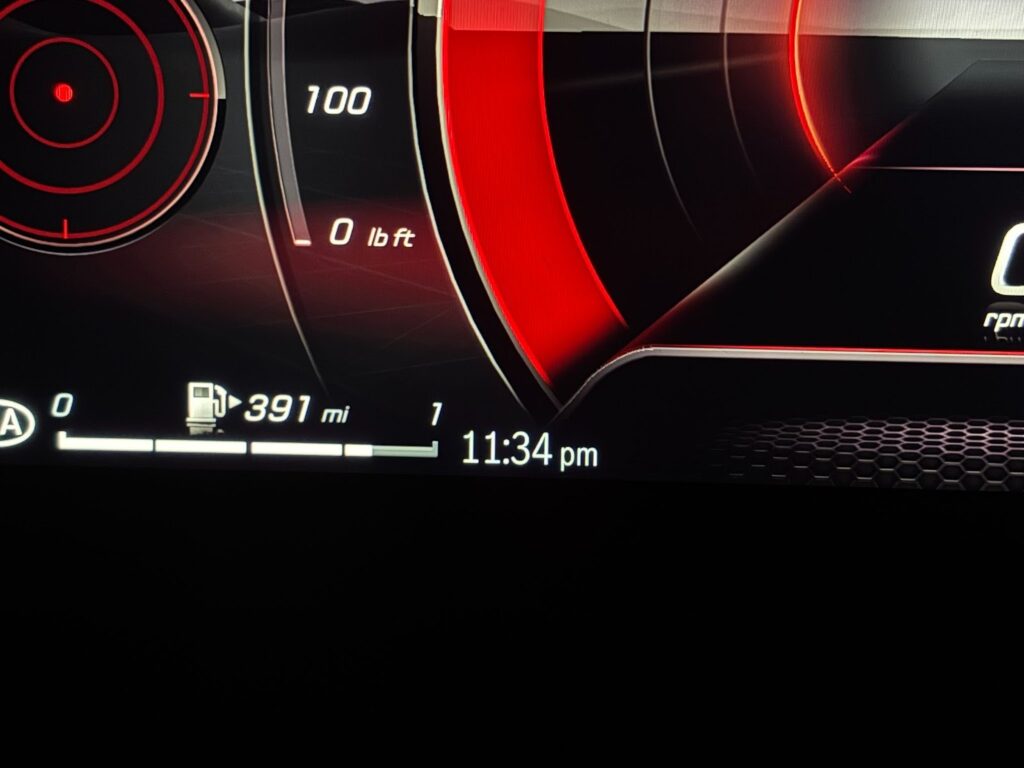
Now we see Ryan’s car dashboard. The time reads 11:34 p.m.
“That’s when I finally clock out and finish my day. I wanted to show what it actually takes.”
Ryan’s day started at 7:00 a.m.
“I woke up at 7 and drove to my economics internship with TD Bank by 8. I worked until 5, then had an hour of rush hour traffic to get back to campus, so I could go to our workspace.”
After a full day at his internship, he heads straight into startup mode.
I just want to be a better version of myself than I was yesterday.
“We’re building content, working on deals, brainstorming. I eat on the go. It’s just nonstop.”
The schedule is demanding, but it reflects something deeper.
“I just want to be a better version of myself than I was yesterday.”
Operating at a professional level, in terms of responsibility and career focus, Ryan’s discipline shows independence, career readiness and responsibility. He is not just managing time. He launched his career while still a college student.
What Does a Startup Workspace Look Like for College Students?
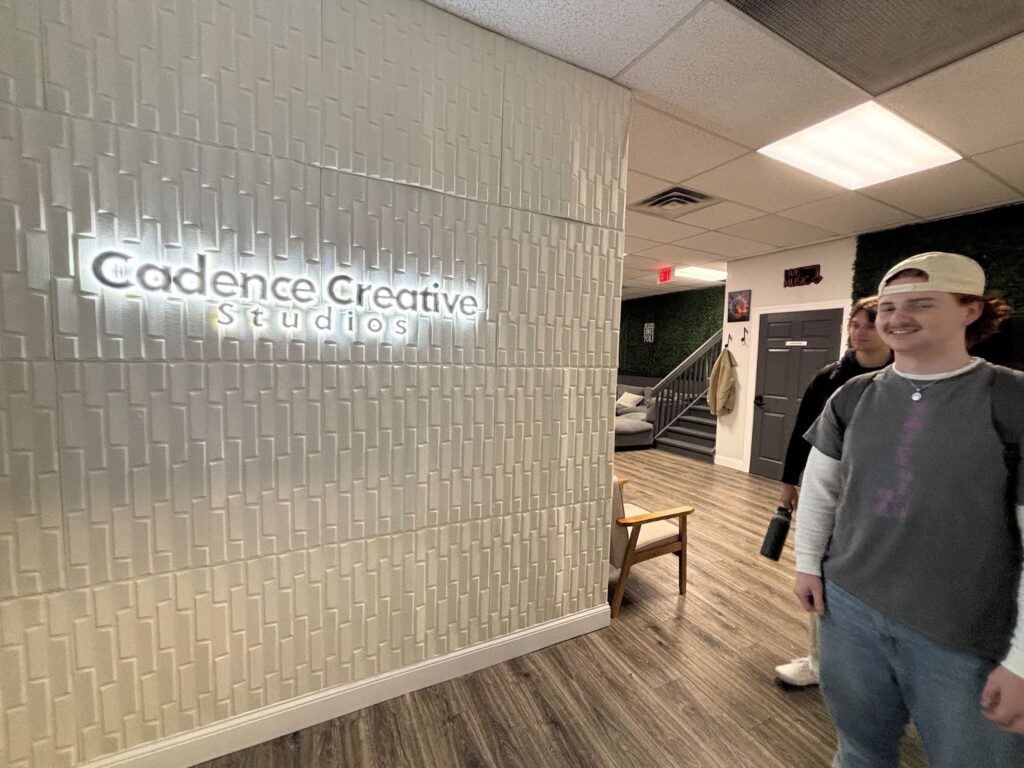
Ryan’s next image shows a shared creative studio space. In one corner stands fellow co-founders, friends he met through Rowan.
“Up front, that’s Braeden. He came up with the idea and he’s our CEO. And behind him that’s Zac, our COO. I met him freshman year.”
Their workspace is not a traditional office. It is a collaborative environment shared with other startups.
“We go there about three days a week. It started once a week, then it just grew.” Their workspace is located in a small town about a five minute drive from campus.
The space came through a Rowan connection.
“I know a professor who introduced us to AccelerateRU. That’s where we met the other startups.” AccerlateRU serves as Rowan’s summer startup accelerator, open to students in any major. The program supports student entrepreneurs. It has funded dozens of student-led companies that have gone on to achieve meaningful real-world and economic impact.
It helps to put yourself in an atmosphere that has the energy you want.
That introduction turned into something bigger. A network.
“With having a dedicated space off campus, it helps you to put yourself in an atmosphere that has the energy you want. The people around me have the same hunger. It’s almost addictive, in a good way,” Ryan shares, explaining why it is so important for he, Braeden and Zac to work in this space, as opposed to reserving collaboration rooms on campus.
In that energized space, that’s where friendships turn into professional partnerships. This evolution reflects one of the most important parts of the college experience: finding people who challenge you, support you and push you forward.
How Do Economics Majors Use Data and Strategy?
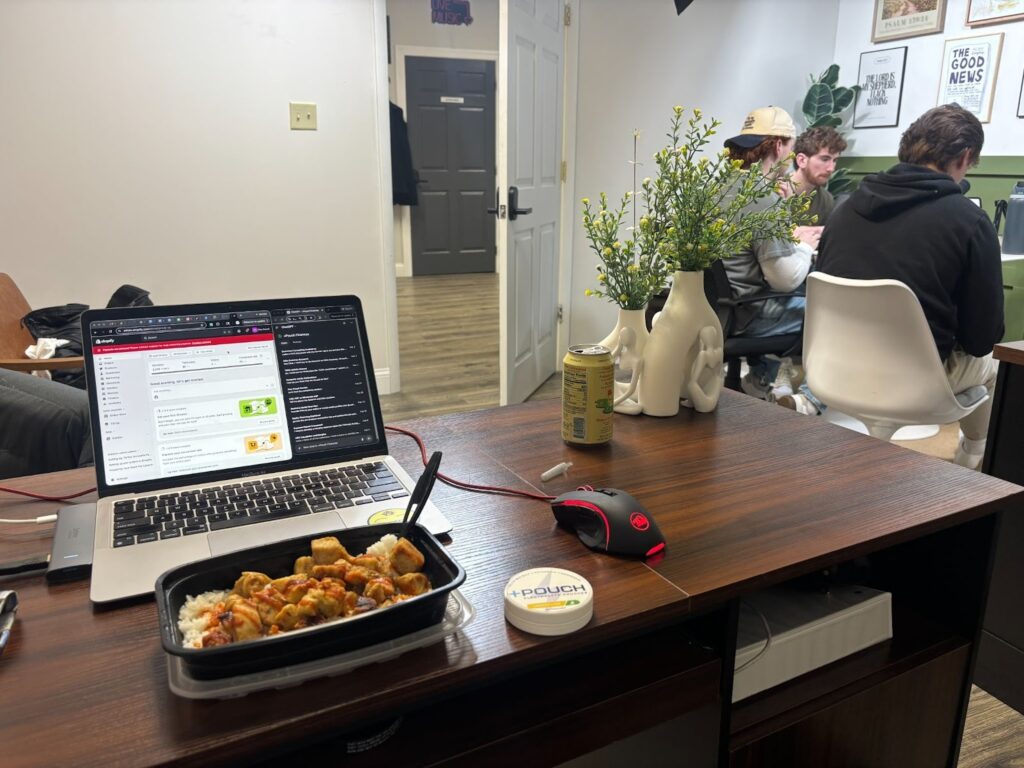
Another image shows Ryan’s laptop open on a desk, food nearby and teammates working in the background.
This moment captures the reality of building a business.
Economics majors use data and strategy to read demand in real time, test pricing and learn what customers actually respond to. From spotting gaps in the market to thinking through competition and risk, the decisions aren’t random — they’re grounded in the same data-driven strategy economics students learn in the classroom, now applied in real time.
“When I took this photo, we were building anticipation for pre-orders. At that moment they were working on figuring out influencers and content strategy.”
At the same time, Ryan is deep in the numbers.
“I was checking Shopify metrics, looking at engagement and tracking everything.” He adds, “I was also gathering IRS documents for a refund at the same time.”
Above Braeden and Zac’s heads, you’ll notice faith-based signs on the walls. Ryan shares, “On that side of the room, we share space with a Christian podcast and that’s where they record it.” The brown couches on the other side of the room double as the space where a coffee-chat-style podcast is recorded.
Ryan’s responsibilities, inspiration and workspace all reflect a mix of personal and professional–exactly what many students experience, but usually after launching their careers post-graduation.
What Skills Do You Learn as an Economics Major?
Economics majors learn how to understand real-world decisions — why people buy, how businesses price and what drives markets. It’s less about theory and more about using data to spot patterns and make smarter calls.
That shows up in everything from tracking performance to understanding customers and positioning a product. Economics gives you a practical, strategic way to think across industries:
- Analyze data and identifying trends
- Understand consumer behavior and decision-making
- Evaluate pricing strategies and market demand
- Assess risk and forecasting outcomes
- Use insights to guide business decisions
There is always someone at Rowan who knows the right person to connect you with. That’s something to consider if you want to do something bigger than yourself.
An Academic Turning Point: Econometrics Class
Ryan points to one economics class that changed everything.
“The most challenging, but rewarding, class I took was econometrics with Professor Melvin.”
Econometrics is where economic theory is tested against real-world data. Students learn to apply statistical methods to analyze relationships, evaluate outcomes, and produce evidence-based insights.
The course builds a strong foundation in using data to support decisions, moving beyond assumptions to measurable results. Concepts learned in econometrics include:
- Applying regression analysis to estimate relationships between variables
- Distinguishing between correlation and causation using established methods
- Testing hypotheses to evaluate economic theories and real-world outcomes
- Identifying and correcting data issues to ensure accurate results
- Using analytical tools such as R, Stata, or Python on real datasets
- Modeling trends and forecasting outcomes using time series and other methods
These skills prepare students to quantify impact and inform decisions across business, policy, and research contexts.
That course pushed him to think differently.
“It was so much work, but it taught me how economics applies to real life. It was a challenge, but it was worth it.”
A Professional Opportunity: It’s Who You Know
Beyond coursework, he credits Rowan’s support system for helping him learn by providing him with growth opportunities, including industry networking.
“I wouldn’t be in this position without my professors. They are honest, always helped and always made the right connections.”
That combination of academic strength and mentorship helped him build confidence.
“There is always someone at Rowan who knows the right person to connect you with. That’s something to consider if you want to do something bigger than yourself.”
What Does a Day in the Life of an Economics Student Look Like?

Professional Expectations at His Internship
One image shows Ryan’s view from the driver’s seat, stuck in standstill rush hour traffic. It is the commute from his economics internship to the startup workspace.
“I leave TD Bank and head straight to Pitman. It’s about an hour.”
Even his internship reflects professional expectations. As an economics major within the William G. Rohrer College of Business, Ryan’s education has been well-rounded, including business concepts as well as overall career readiness skills.
Reflecting on the photo, Ryan says, “I have to wear a tie, dress shirt and dress pants every day. It’s not casual.” Having the astuteness to know how to fit in professionally at an internship is a career skill in itself, and one that Rowan faculty and staff help students to achieve.
Faculty Mentorship and Support
Speaking of faculty, Ryan is immensely grateful for the mentorship and close professional relationships he has with his professors. “I was hired for my internship in mid-January and the training period interfered with my class time,” he says. “My professors worked with me, creating flexibility where I could commit to this internship while also wrapping up my last academic requirements as a graduating senior.”
All of these experiences help to build skills in professional conduct and prepare him for his career.
Preparing for Pitch Competitions
In the coming weeks, Ryan and his team are preparing for multiple pitch competitions.
“We have four pitch competitions coming up. We’re trying to make the most of the time we have before graduation.”
He maintains a laser focus these last few weeks, before earning his economics degree and as Plus Pouch accepts pre-orders ahead of its product launch. Ryan shares, “My philosophy is: There’s nothing else to do other than do your schoolwork and work on your business. Just do what’s on your plate and be the best at it.”
What Is an Economics Major?
Students studying economics learn how to break down real-world decisions — from why people buy to how markets move and businesses grow. The program combines economic theory with hands-on data analysis, helping students think strategically and back up decisions with evidence.
Coursework spans microeconomics, macroeconomics, econometrics and behavioral economics, giving students the tools to analyze trends, test ideas and understand what drives outcomes. Along the way, students build strong analytical and problem-solving skills that apply across industries.
Hands-on experience is a key part of the program. Through internships, research and applied projects, students work with real data and real scenarios, building experience that translates beyond the classroom. Graduates go on to careers in business, finance, consulting, government, data analysis and other fields where understanding data and making smart decisions matter.
What Can You Do With an Economics Degree?
An economics degree opens the door to a wide array of career opportunities across various industries. Economics major jobs include roles such as:
- Financial analyst: Assess financial data to guide business decisions.
- Economic consultant: Analyze economic trends to advise organizations.
- Policy analyst: Evaluate and develop policies for governmental or non-governmental organizations.
- Market research analyst: Study market conditions to determine potential sales of a product or service.
- Data analyst: Interpret complex data to help companies make informed decisions.
The demand for economics professionals spans sectors such as finance, healthcare, education and government. The analytical and problem-solving skills acquired through the program are highly valued, offering graduates a competitive edge in the job market.
Ryan’s experience shows that economics is not limited to traditional roles. It can also lead directly to entrepreneurship and innovation.
According to the U.S. Bureau of Labor Statistics, roles in economics-related fields often offer strong earning potential and long-term growth.
Ryan is already on that path.
With a full-time role at TD Bank ahead and a startup gaining momentum, he is entering the workforce with both experience and direction.
FAQ: Economics Major, Careers and Student Experience
What can you do with an economics major?
You can work in finance, business, data analysis, consulting or start your own company. The degree focuses on decision-making and strategy, which apply across industries.
Is economics a good major for careers?
Yes. Economics builds analytical and financial skills that are highly valued by employers. It prepares students for both corporate roles and entrepreneurship.
Do economics majors get real-world experience?
Yes. Many students complete internships, research or start businesses. These experiences help apply classroom learning to real situations.
What skills do economics students learn?
Students learn data analysis, financial modeling, problem-solving and strategic thinking. They also develop communication and decision-making skills.
Can you start a business with an economics degree?
Yes. Economics provides the foundation for pricing, budgeting and strategy, which are essential for building and managing a business.
About Rowan
The fastest-growing public research institution in the Northeast and among the country’s top 10 fastest-growing, Rowan University is home to a thriving multidisciplinary environment with a strong emphasis on practical research at the intersection of health care, engineering, science and business.
Carnegie-classified as an R2 (high research activity) institution and operating at R1 (very high research activity), the University partners with industry, government and nonprofit organizations in New Jersey and beyond to drive innovation, while developing the future workforce. Students are essential contributors, presenting at national conferences, sharing credit in professional publications and earning recognition for their work. Selected entrepreneurs receive support through the Rowan Innovation Venture Fund.
Rowan’s partnerships with Virtua Health, Cooper University Health Care and all major health care systems in southern New Jersey distinguish the region as a hub for health care research and education. Rowan is also a key partner with the New Jersey Economic Development Authority in two strategic innovation centers focused on medical technology.
Internship & Experiential Learning Stories
Learn how Rowan Profs go beyond the classroom to grow professionally, as well as personally, through internships and other experiential learning. Experiential learning includes hands-on learning opportunities provided through research, student clubs, campus leadership, student worker jobs, service-learning projects and volunteerism. In addition, Rowan’s Career and Professional Development Services Office provides career support that’s more than just advice – it’s events, connections and real guidance to help students thrive after college.