
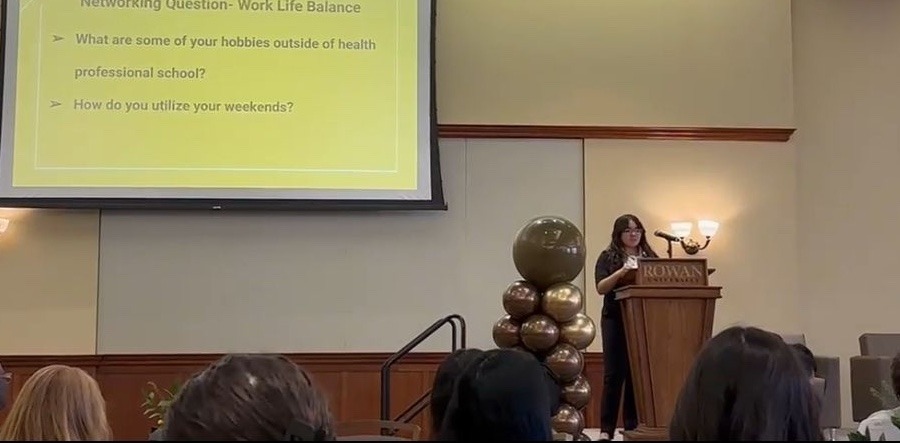
Some students talk about college as preparation for “the real world.” For future veterinary school student and recent graduate with a bachelor’s degree in biological sciences, Kayla B., that line doesn’t really exist. At Rowan University, her academic life, fieldwork, friendships and leadership roles all overlapped—sometimes in the same week, sometimes in the same day.
In this life-on-film-inspired feature, her camera roll from one week at the end of spring semester tells the story better than any résumé ever could.
Biology Internship & Veterinary Shadowing
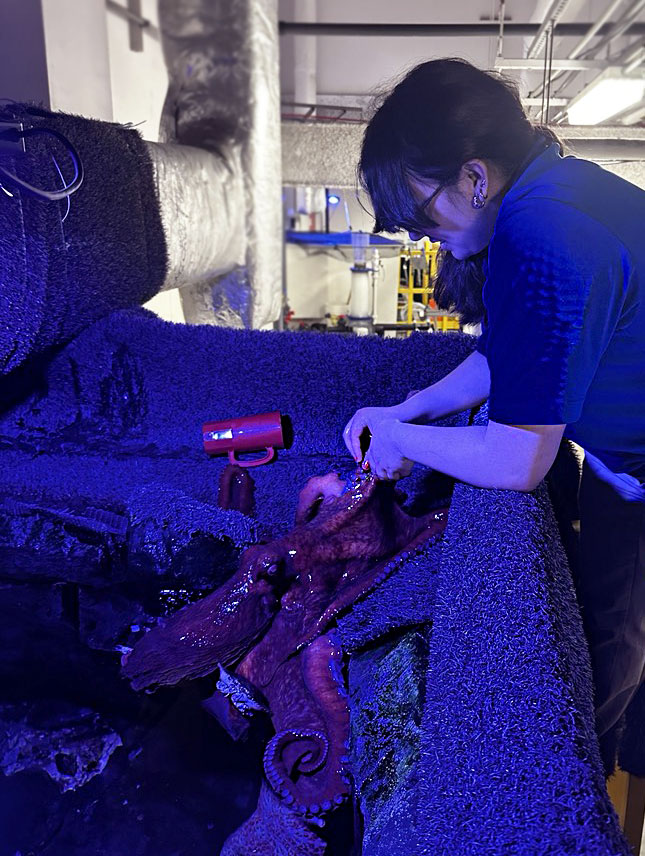
If you scroll through Kayla’s photos, one stands out immediately: a giant Pacific octopus named Phoenix at Adventure Aquarium.
Phoenix is not just an animal she studies—she’s an individual Kayla knows personally.
“She recognizes me,” Kayla says. “She knows the difference between me and a coworker, or someone new.”
As a fish invertebrates intern, Kayla spent time observing Phoenix’s behavior, feeding enrichment toys like a small boat filled with frozen clams, and even watching her problem solve. Phoenix changes color based on emotion, shifts her skin texture when engaged, and interacts with caretakers in ways that feel surprisingly intentional.
But the moment captured in the photo wasn’t exactly calm.
“I was trying to get the picture,” she laughs. “And she started squirting water at me.”
Her shirt is visibly wet in the image—proof that marine biology is not always clean, quiet or predictable.
Still, Kayla describes the experience with admiration: “It’s like having an intelligent puppy … just underwater.”
That internship also introduced her to veterinary shadowing, where she’s seen everything from anesthesia protocols to diagnostic imaging across species as different as penguins, porcupines and poison dart frogs. No textbook prepares you for that level of variability.
“You can’t just look it up,” she says. “A lot of it is learning on the spot.”
Expanding upon that on-the-spot learning, Kayla offers, “South Jersey really does have a lot of animal experiences that are outside of the typical ones,” she says. “I can go to the fossil park,” she says, sharing that through a previous internship at Edelman Fossil Park & Museum of Rowan University she managed the horsehoe crab visitor program. “I am volunteering with the aquarium later this week, doing horseshoe crab surveying.”
Her College Roommate Became Her Best Friend
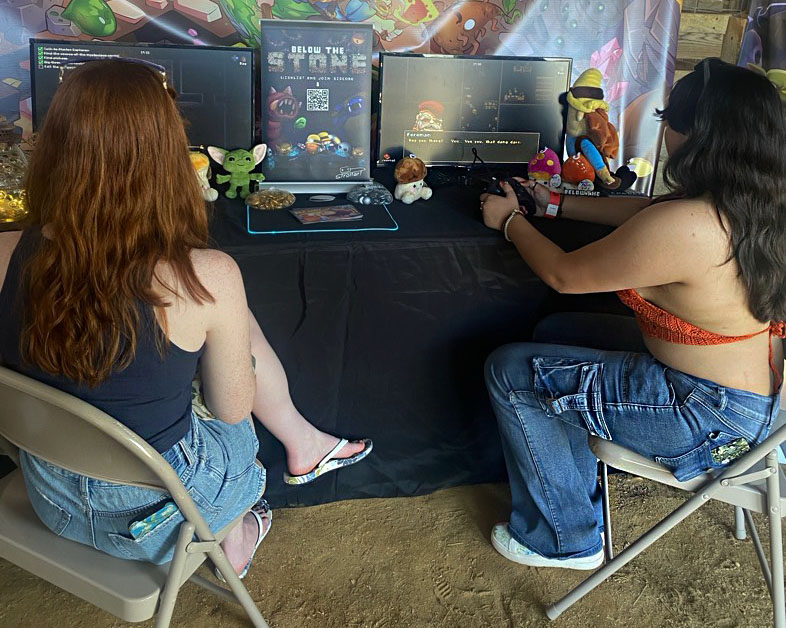
Another photo shows Kayla sitting across from her best friend, both leaning toward a game setup at a local festival.
It looks casual—but the friendship behind it started long before college move-in day.
The two met through an online roommate matching platform after discovering they were both entering similar academic tracks. They met in person during Accepted Students Day, decided not to risk a random roommate assignment, and made a choice that would shape the next chapter of college life.
“We were like, let’s just be roommates,” Kayla says.
Even after no longer living together their routines still intertwined—shared dinners, shared labs, shared classes and shared weekends exploring South Jersey events like Geek Fest.
The photo captures something simple: two students competing in a game. But the story behind it reflects something larger—how quickly college friendships can become permanent anchors.
Learning Professional Skills Through Biology Lab Experience
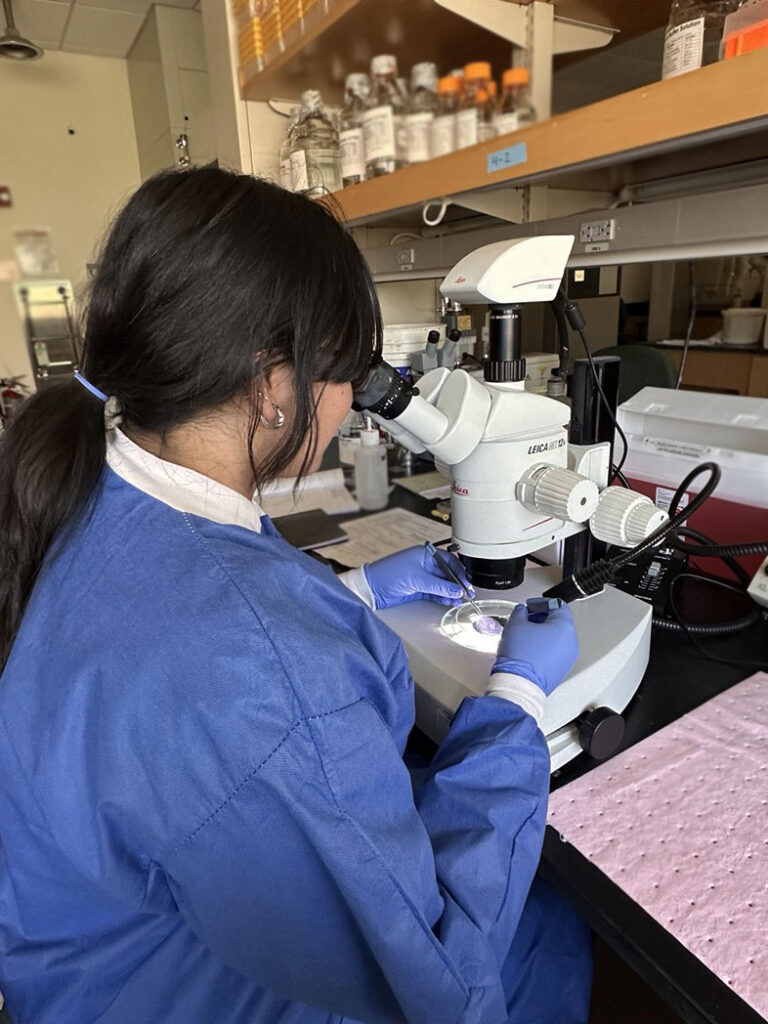
In a quieter image, Kayla is alone in a lab coat, eyes focused into a microscope.
This was her developmental biology lab work, studying chameleon embryonic development—specifically how sex cells migrate and what determines biological sex in reptiles.
Unlike mammals, reptiles don’t follow a single system. Some are genetically determined, others environmentally influenced, and some remain unknown entirely.
“That’s what makes it interesting,” she explains. “We’re still figuring it out.”
Her research tracked when sex cells became identifiable during development and how they move toward gonads over time. That data may help answer broader biological questions about sex determination in reptiles—and potentially inform veterinary and ethical practices in embryology.
But the work also raises difficult ethical considerations, including how embryos are handled in research environments.
“It’s something that needs to be studied,” she says, adding, “It also forces you to think about responsibility.”
Even with its complexity, she’s clear about her future direction: research is meaningful, but she doesn’t want it to be her entire career.
“I don’t want to sit at a microscope all day,” she admits. “I got into this because I love animals.”
Kayla knew that immersing herself in new experiences was key to her professional growth, so she took full advantage of every opportunity she could at Rowan to learn all she could. The Department of Biological & Biomedical Sciences routinely hosts research talks, giving a platform to both Rowan researchers and researchers not affiliated with Rowan. Kayla attended one such session, in which Natasha Shylo Hyson, Ph.D. spoke about her chameleon research on sex determination.
“I thought it was super cool because I was thinking about potentially going into reproductive medicine,” Kayla says. “I went to her talk and I really liked it. At that point I was looking to join a research lab, so I just talked to her. She said, ‘Send me over your resume.’ I started working with her last year.”
Making Friends & Growing Skillsets Through Work Study
Not all of Kayla’s experiences are clinical or scientific.
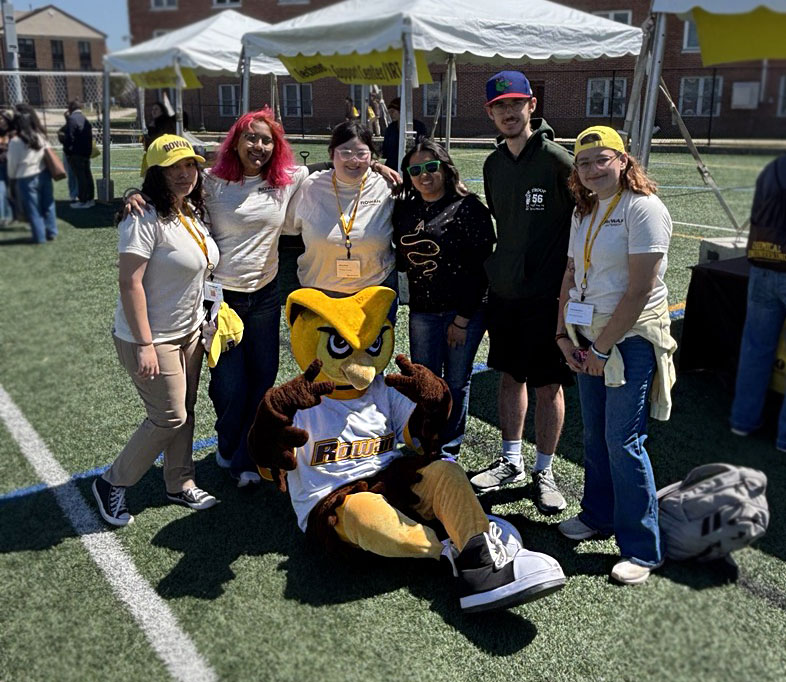
One photo shows her standing outside at Accepted Students Day with friends and Rowan’s mascot in the background. The scene is bright, social, and full of movement.
Many of the people in the photo are student leaders or orientation staff, roles that Kayla herself understands deeply as a community assistant (CA) within Residential Learning & University Housing.
That position, she says, taught her something different than lab work: decision-making under pressure.
“You don’t always know what you’re walking into,” she says, describing late-night duty calls and unexpected situations in residence halls. “But you learn to ask the right questions first.”
Over time, she built a system: clarify details early, assess situations calmly, and rely on a strong support network of fellow CAs and professional staff.
“It’s not that you’re alone,” she explains. “It’s that you learn how to be prepared.”
In addition to the benefits of making friends and growing her skillsets through work study, dedicating herself to her community assistant position helped her to keep the cost of her education more affordable. (Community assistants, formerly known as resident assistants or RAs, earn free housing.)
“I knew from the beginning that veterinary school was going to be very expensive,” she says. “So I was trying to save as much as I could during undergrad, so that I could choose whichever vet school I wanted to go to.” This fall, Kayla begins vet school at Cornell University.
Prioritizing Health & Wellness as a College Student
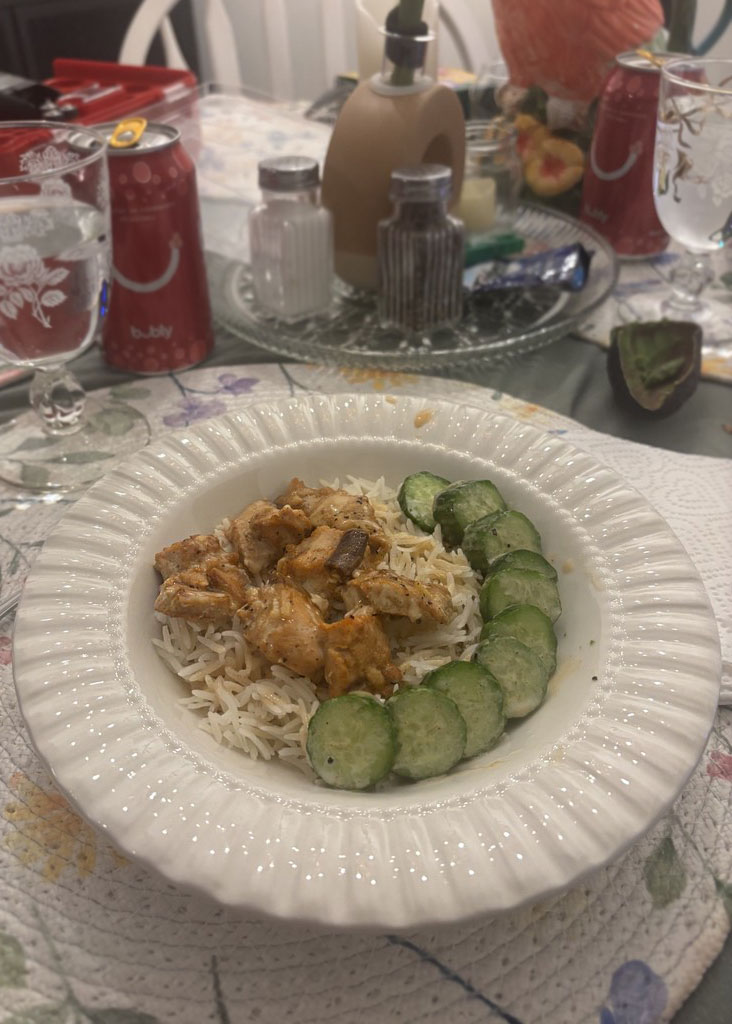
One of the most grounded images in Kayla’s collection is a simple plate of food: salmon, rice and cucumbers.
No lab coats. No fieldwork. No leadership roles. Just dinner.
Every Tuesday night, she would cook dinner with two close friends—also biology majors who were preparing for veterinary school. They rotated roles naturally: one would bring groceries and recipes, others cooked and cleaned, and all three shared the table.
“It’s our time,” she says. “We would just eat and hang out.”
What looks like a casual meal is actually a structured ritual—an intentional pause in an otherwise packed schedule.
Kayla explains, “My meal times are my time. I do not do any homework; I don’t look at the news. I don’t do anything that has to do with academics. That is the time that I would spend with friends.” Treating her three square meals a day as personal time created balance for Kayla. “I structure my meal times around being able to see other people and being able to have a life. And, through that, I continue to have a life.”
Finding Community & Expanding Her Horizons
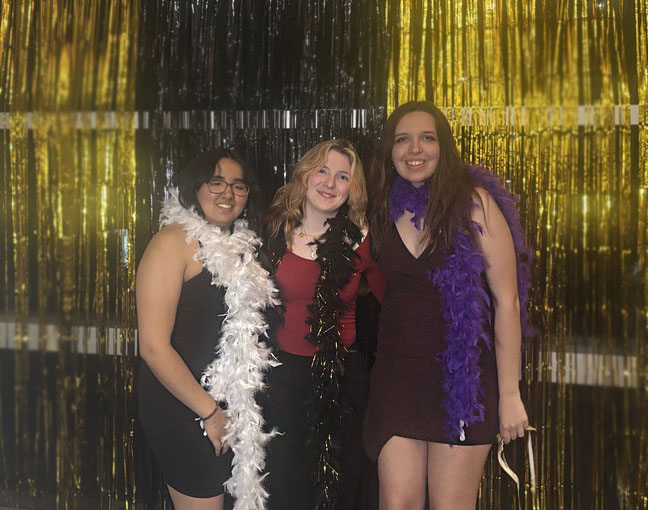
Another image shows Kayla at a Society of Women Engineers Ball, standing with friends dressed in coordinated formalwear.
She was not an engineering student, but she attended anyway.
“I went every year to support them,” she says. “All of my friends are engineers.” She adds that she makes a point to schedule time together with these two friends once a week.
The photo captures something important about her college experience: belonging isn’t always defined by major. Sometimes it’s defined by community.
The Bigger Picture: Graduating Early, But Not Rushing Through It
Kayla graduated a year early, a decision she made after realizing she was close to completing her credits.
It wasn’t about pressure. Instead, it was about planning.
“I can close this chapter,” she says. “And start the next one.”
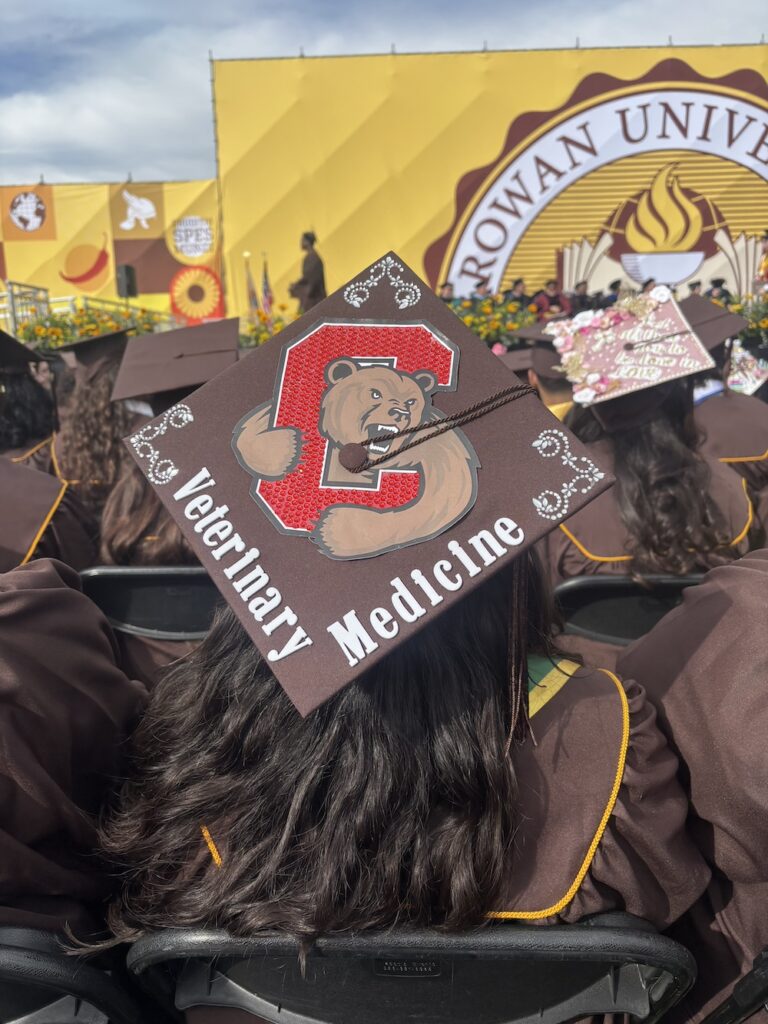
That next chapter is veterinary school at Cornell University, built on a foundation of lab research, clinical exposure, leadership experience and animal care across multiple environments.
On her graduation gown, she carried cords, stole, and a medallion representing academic achievement, leadership roles, and professional distinction. It was heavy—but meaningful.
Final Frame: What Rowan Looks Like Through Her Lens
When asked what has shaped her most at Rowan, Kayla doesn’t hesitate.
“It’s the people,” she says. “And the experiential learning.”
From aquarium tanks to research microscopes, from residence hall duty calls to Tuesday night dinners, her week isn’t divided into categories—it’s blended into one continuous experience.
Rowan, for her, is not just a place to study biological sciences and the animals she is interested in.
It’s a place to learn how to live among them, care for them and ultimately build a career around understanding them.
And sometimes, it’s a place where a curious octopus sprays you with water just long enough to remind you that you’re exactly where you’re supposed to be.
Internship & Experiential Learning Stories
Learn how Rowan Profs go beyond the classroom to grow professionally, as well as personally, through internships and other experiential learning. Experiential learning includes hands-on learning opportunities provided through research, student clubs, campus leadership, student worker jobs, service-learning projects and volunteerism. In addition, Rowan’s Career and Professional Development Services Office provides career support that’s more than just advice – it’s events, connections and real guidance to help students thrive after college.
About Rowan’s Biological Sciences Major
Students studying biological sciences explore the living world, from cells and genetics to ecosystems and human health. Through coursework in biology, chemistry and laboratory sciences, students develop the scientific knowledge, research skills and critical thinking needed to investigate complex biological questions.
Experiential learning through research, internships and fieldwork gives students opportunities to apply classroom knowledge while preparing for careers in healthcare, biotechnology, environmental science, research and beyond.
The bachelor of science (BS) in biological sciences gives future researchers and medical professionals a solid foundation for future graduate study and professional experience. The bachelor of art (BA) in biological sciences is ideal for students who do not plan to pursue careers as scientific researchers, and will instead pair the degree with a complementary discipline applicable to their professional path. Both programs are available on Rowan’s Glassboro, NJ, campus. In addition, Rowan Online offers a BA in biological sciences.
About Rowan
The fastest-growing public research institution in the Northeast and among the country’s top 10 fastest-growing, Rowan University is home to a thriving multidisciplinary environment with a strong emphasis on practical research at the intersection of health care, engineering, science and business.
Carnegie-classified as an R2 (high research activity) institution and operating at R1 (very high research activity), the University partners with industry, government and nonprofit organizations in New Jersey and beyond to drive innovation, while developing the future workforce. Students are essential contributors, presenting at national conferences, sharing credit in professional publications and earning recognition for their work. Selected entrepreneurs receive support through the Rowan Innovation Venture Fund.
Rowan’s partnerships with Virtua Health, Cooper University Health Care and all major health care systems in southern New Jersey distinguish the region as a hub for health care research and education. Rowan is also a key partner with the New Jersey Economic Development Authority in two strategic innovation centers focused on medical technology.