
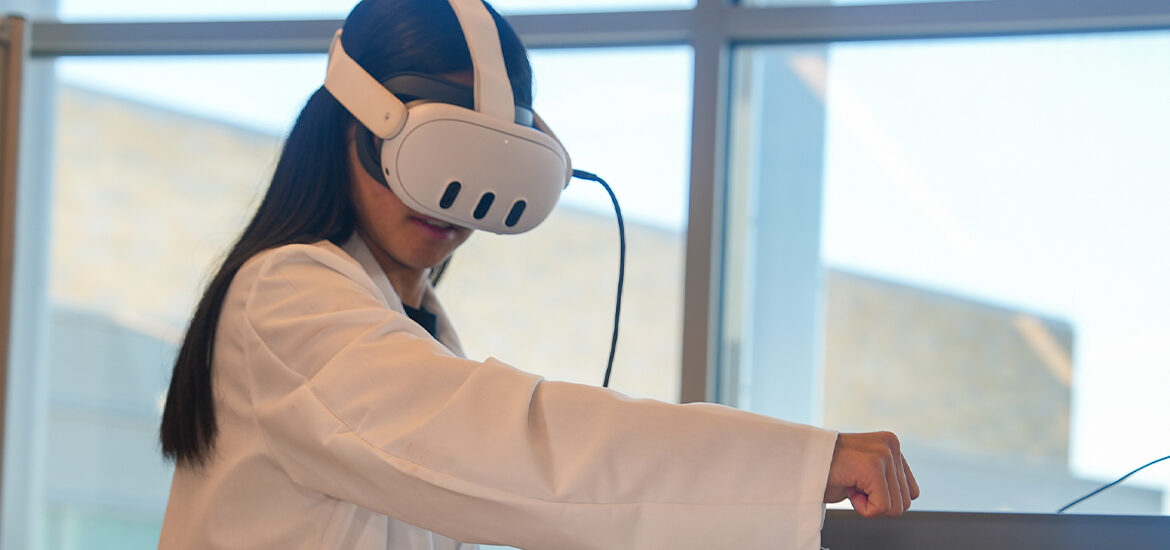
For Gabriella P., engineering has never been confined to a classroom.
As a senior electrical and computer engineering major, she has researched drone detection using artificial intelligence, designed a virtual reality interface, explored sustainability through an interdisciplinary internship and gained professional experience at an energy company through a second internship. She has also spent countless hours training, competing – and winning – as a student-athlete.
And somehow, all of those experiences connect.
“I feel like everything in engineering is just you’re continuously learning,” Gabriella says. “You can think you know one thing, but maybe it applies to a different principle in one way, but you learned it in the classroom another way.”
For Gabriella, that connection between learning something in theory and applying it in the real world is exactly what makes engineering exciting.
What Can You Do With an Electrical and Computer Engineering Degree?
Graduates with an electrical and computing engineering degree can work in fields such as robotics, automation, semiconductor design, aerospace, defense, telecommunications, consumer electronics, software systems and energy. Electrical and computing engineering combines electrical engineering, computer engineering and programming, preparing students to design and understand technologies including computers, microprocessors, networks, digital systems, robotics, chip design, communications, signal processing and power systems. The broad technical foundation gives graduates the flexibility to apply their skills across industries where computing, electronics and engineering come together.
Gabriella’s experiences show just how many directions an electrical and computer engineering degree can take a student.
Her academic work has included engineering clinics and undergraduate research. Her internships have exposed her to sustainability, virtual reality, project management and energy technology. And her current engineering clinic involves artificial intelligence and radio-frequency drone detection. She is also honing her interest in sustainability.
“That’s what I love about engineering,” she says, “taking the things that you learn in theory and then applying them to real life.”
That hands-on approach started early in her Rowan experience.
Engineering students complete clinics throughout their undergraduate education, gaining experience working on projects that require research, technical communication, teamwork and problem-solving.
Gabriella says she did not initially realize how much those early courses were preparing her for professional work.
“You don’t really realize how strong of a base is needed until you go off and you work,” she says. “And then, oh my gosh, look at all these things that I’ve learned.”

How Experiential Learning Prepares Engineering Students for Careers
Gabriella’s first major sustainability experience came through an internship the summer after her sophomore year, with the PSEG Institute for Sustainability Studies at Montclair University.
Her team included students from other universities studying engineering, horticulture, computer science and ecology and evolution. Together, they created a virtual reality prototype to supplement workforce training for Greens Do Good, a nonprofit vertical farm in Paterson, NJ. Part of the mission of Greens Do Good is to promote neurodiversity in the workplace by providing meaningful job training and employment for teens and adults with autism.
Over the course of the 10-week internship, Gabriella and her team created two VR training modules for the nonprofit, to better support their employees.
The project introduced Gabriella to a side of sustainability she had not previously considered.
The experience also helped her discover the value of interdisciplinary work.
“I think that multidisciplinary teams are probably one of the most valuable teams that you can work on,” Gabriella says.
Engineering projects rarely exist within a single discipline. Electrical engineers may need to collaborate with mechanical engineers, civil engineers, computer scientists and others.
“Engineering is a huge, huge field,” she says. “Whenever you really want to put the full picture together, you need a full team.”

From Engineering Research to Artificial Intelligence
Gabriella brought what she learned through her internship back to Rowan, creating what she describes as a full-circle learning experience.
In a previous engineering clinic, she redesigned a user interface for a virtual reality project. Now, in a summer engineering clinic, she is working with Dr. Huaxia Wang using radio frequencies.
The project uses an antenna to record radio frequencies emitted by drones. Gabriella and her team annotate the data on spectrograms, then train artificial intelligence to recognize patterns associated with specific drones. Dr. Wang’s goal is to advance drone detection technology.
“It was like this full circle moment where I learned so much stuff from Rowan, I put it into the PSEG Institute for Sustainability Studies at Montclair University; then I learned all this stuff from the Institute and then I put it back into Rowan,” she says.
That cycle of learning, applying and bringing new knowledge back to the classroom has become a defining part of her education.

Becoming a Leader Through Engineering Experience
The next year, the summer after her junior year, she returned to the PSEG Institute for Sustainability Studies at Montclair University as an assistant project manager, overseeing two teams of interns – one for Greens Do Good and the other team for the Foodshed Alliance in Newton, NJ.
The role gave her the opportunity to turn her own experience into a resource for other students. The report she had written with her cohort of interns during her first internship became a reference point for the next group she supervised.
Her teams expanded the original project and developed new work of their own.
“It was amazing,” she says of seeing the next group build upon her team’s work. “The prototype that my original group created the year before was a very good base for them to start off with.
“Our report and presentation was amazing and well received,” she continues, sharing the totality of the project and the two training modules they created the summer before. “But the next cohort, the interns I supervised, they absolutely knocked it out of the park,” she says with pride. “Their report and presentation were even better than ours – and they were able to add six new training modules, which was amazing.”
Through the experience, Gabriella intrinsically grew leadership skills. Gabriella says the experience also taught her how important empathy and communication are to leadership.
“I was very empathetic towards my interns,” she says, supporting their professional growth throughout the summer.
How an Engineering Clinics & Engineering Internships Build Professional Skills
Gabriella’s classes and internships have also shown her that engineering careers require more than technical knowledge. Communication, collaboration and presentation skills are crucial – and they are all skills Gabriella is using at her current internship with Bloom Energy.
She credits Rowan’s engineering clinics with helping her develop these professional skillsets.
Rowan engineering clinics are a continuous, eight-semester sequence of hands-on laboratory, design, and research projects that form the core of the undergraduate curriculum at the Henry M. Rowan College of Engineering. Inspired by the medical education model, they bring students and faculty together every semester to solve real-world problems, in cross-disciplinary teams that span every engineering discipline.
At Bloom, Gabriella is preparing a final poster presentation about her work, much like the presentations she has completed at Rowan for engineering clinics. She flew to San Jose, CA, where Bloom hosted its cohort of 100 summer interns to present their posters. She learned from, and networked with, fellow Bloom interns across the country from a wide range of disciplines, including students majoring in finance, data analytics and communications.
The connection between her academic and professional experiences has helped her enter the workplace with greater confidence.
“You could be the smartest person on the planet, but if you can’t communicate your ideas to somebody else, your contributions are not as valuable,” she says.
How Being a Student-Athlete Shapes an Engineering Student
For Gabriella, engineering is only one part of her Rowan experience.
She is also a member and captain of Rowan Athletics’ track and field program, competing in cross country and indoor and outdoor track.
Her athletic accomplishments include being named the New Jersey Athletic Conference cross country Runner of the Year, qualifying for NCAA Division III nationals and earning Second Team All-American honors in the 5K. She also broke Rowan and NJAC records and helped her team win its conference meet.
But the value of being a student-athlete goes beyond the competition.

“Being a student athlete has enhanced my academic life because it gives my day structure,” Gabriella says. She notices a symbiotic relationship between academics and athletics. When she was injured and not competing her freshman year, that is when her grades were the lowest. Her most recent year was her strongest, both academically and athletically.
Practice gives her a predictable part of every day, while her teammates provide a community and a reason to step away from academics.
“If I was having a bad day for whatever reason, by the time I roll up to practice and I see all my teammates, it’s not a bad day anymore,” she says. “We go for a run, we talk. We just enjoy each other’s company.” Gabriella finds that being a student-athlete builds into her schedule a deliberate, day-to-day focus on health and wellness.
In addition, “One of the unique benefits of being a student-athlete is that you get to travel with your friends,” Gabriella says, sharing that her travels have taken her to Boston, Washington D.C., Atlanta, Virginia, Indiana and more.
When Gabriella and a member of the men’s team qualified for a meet in South Carolina, “About 10 of our teammates drove from New Jersey to South Carolina to support us. They surprised us and everything. It was amazing,” she says.
Her coach pointed out to her that her teammates were willing to travel because it is a reflection of the impact she has made on them.
After Gabriella completes her collegiate career running, she plans to continue to run semi-professionally.

Learning Time Management as an Engineering Student-Athlete
Balancing engineering, athletics, internships, research and leadership has required Gabriella to become intentional about her time.
She keeps a notebook where she writes down everything she plans to accomplish each day and uses gaps between classes to complete schoolwork. Having an up-to-date calendar and schedule helps Gabriella to stay focused and organized.
“If I have class from 8 a.m. to 9:15, and then I have nothing from 9:15 to 11, that’s when I have to do my homework,” she explains. “I tell myself, ‘Put the phone away.’ This is when I have to do my homework. I look at my notebook and can see if I am busy for the rest of the day and if this is literally the only time that I have to do my homework.”
That discipline is a skill she expects to carry into her career.

Where Can an Electrical and Computer Engineering Degree Take You?
Gabriella’s path demonstrates that an engineering degree does not have to lead to a single, predetermined career.
Her interests have taken her from sustainability and virtual reality to artificial intelligence, energy technology, research and project management. Along the way, she has learned how to communicate across disciplines, lead teams and apply classroom knowledge to real-world challenges.
And she is not finished learning.
After completing her undergraduate degree, Gabriella plans to pursue a master’s degree in electrical and computer engineering at the University of Delaware while continuing to run competitively.

Build Your Engineering Experience at Rowan University
Gabriella’s experience reflects the value of combining classroom learning with research, engineering clinics, internships, athletics and other opportunities to apply knowledge beyond the classroom.
At Rowan University, engineering students gain hands-on experience beginning their very first semester. These experiences drive the development of the technical, communication and collaboration skills needed to contribute to complex, multidisciplinary projects.
For Gabriella, those experiences have made her more than an engineering student.
They have helped her become a researcher, intern, leader, teammate and emerging professional — all while discovering how the different pieces of her education fit together.
“I feel like everything in engineering is just you’re continuously learning,” she says.
And for Gabriella, that may be the most important lesson of all.

Internship & Experiential Learning Stories
Learn how Rowan Profs go beyond the classroom to grow professionally, as well as personally, through internships and other experiential learning. Experiential learning includes hands-on learning opportunities provided through research, student clubs, campus leadership, student worker jobs, service-learning projects and volunteerism. In addition, Rowan’s Career and Professional Development Services Office provides career support that’s more than just advice – it’s events, connections and real guidance to help students thrive after college.
About Rowan’s BS in Electrical & Computing Engineering
Rowan University’s Bachelor of Science (B.S.) in Electrical & Computing Engineering prepares students to design the technologies that power today’s connected world. Coursework combines electrical engineering, computer engineering, programming, electronics and embedded systems while helping students build strong analytical, technical and problem-solving skills.
Through small class sizes, faculty mentorship, internships and industry partnerships, students develop the technical expertise, problem-solving abilities and professional skills needed for success in a wide range of engineering careers. Students also have opportunities to participate in undergraduate research and explore specialized interests across emerging areas of chemical engineering.
Graduates pursue careers in robotics, automation, communications, semiconductor design, aerospace, defense, consumer electronics and software systems or continue their education through graduate study.
About Rowan
A top 100 national public research institution, Rowan University offers bachelor’s through doctoral and professional programs in person and online to nearly 25,000 students. The fastest-growing public research institution in the Northeast and among the country’s top 10 fastest-growing, Rowan offers a thriving multidisciplinary environment with a strong emphasis on practical research in health care, engineering, science and business, while ensuring excellence in undergraduate education. Nationally recognized for innovation, high-quality, affordable education and public-private partnerships, Rowan is one of two universities in the U.S. to offer M.D., D.O. and D.V.M. degree programs.