

May Is a Time to Celebrate Small Business Owners
May is a meaningful time to recognize the creativity, determination and economic contributions of small business owners at Rowan University, throughout New Jersey and across the country. Throughout the month, celebrations like Small Business Week honor the entrepreneurs and small business owners whose ideas, hard work and innovation strengthen communities and drive the economy.
Beyond celebration, Small Business Month also serves as a reminder of something every entrepreneur knows: running a business takes more than passion. It requires strategy, adaptability, financial confidence, leadership, marketing knowledge and the ability to make smart decisions under pressure.
For many business owners and aspiring entrepreneurs, business education can be one of the smartest investments they make. The right program can help founders build the leadership, financial literacy, operational and strategic skills needed to make better decisions, reduce risk and grow sustainably.

What Skills Does Every Small Business Owner Need?
Small business owners need a broad mix of skills to start, manage and grow a successful business. Some of the most important small business owner skills include strategic decision-making, leadership, financial management, marketing, customer acquisition, operations, adaptability and problem-solving.
Together, these skills help entrepreneurs manage risk, serve customers, lead teams and build businesses that can grow over time.
Why Small Business Skills Matter
Small businesses are a powerful part of the U.S. economy. According to the U.S. Small Business Administration, small businesses account for 99.9% of all U.S. businesses. They employ 62.3 million people and represent 45.9% of private-sector workers.
That impact is significant, but so are the challenges. Many founders are experts in their product, service, craft or industry, but may still need support in areas like finance, marketing, operations, hiring, pricing, customer strategy or long-term planning.
That is why Small Business Month is not only an opportunity to celebrate entrepreneurs but also a time to reflect on the skills, knowledge and resources small business owners need to keep moving forward.
Whether someone is launching a new idea, running a family business, growing a side hustle or preparing to scale an existing venture, education can help turn uncertainty into strategy and ambition into action.
The Skills Modern Entrepreneurs Need to Grow
Anyone can learn how to start a business or file the right paperwork. But building a business that lasts requires a deeper foundation. Small business management often requires owners to wear many hats, especially in the early stages. The following business skills for entrepreneurs can help founders make stronger decisions, become more confident leaders and create sustainable paths for growth.
Strategic Decision-Making
Every day, entrepreneurs make choices that affect finances, operations, customers, employees and long-term sustainability. Strategic decision-making helps business owners evaluate options, understand trade-offs and make choices based on data, goals and market realities.
Business education gives entrepreneurs frameworks for thinking clearly and planning ahead. Instead of reacting to every challenge as it comes, founders can learn how to take smart risks, identify opportunities and make decisions that support long-term growth.
Leadership and Team Development
Businesses grow when leaders grow. Even a small business with only a few employees needs clear communication, trust, accountability and a strong sense of direction.
Leadership skills help entrepreneurs hire intentionally, motivate teams, manage conflict and build workplace cultures where people want to contribute. As a business grows, the owner’s ability to lead becomes just as important as the original idea behind the business.
Finance and Budgeting
Financial literacy is one of the most important skills for any small business owner. Cash flow, pricing, budgeting, forecasting, taxes, funding and valuation all affect whether a business can survive and scale.
A business degree for entrepreneurs can help founders better understand the numbers behind their decisions. With stronger finance skills, business owners can plan for expenses, manage risk, evaluate investments and make more confident choices about growth.
Marketing and Customer Acquisition
A strong business idea still needs the right audience. Marketing helps entrepreneurs understand who their customers are, what they need and how to reach them.
Skills in branding, digital marketing, consumer behavior and customer acquisition allow small business owners to stand out in competitive markets. They also help founders build relationships with customers, communicate value clearly and create strategies for attracting and retaining business over time.
Operations and Scaling
As a business grows, systems matter. Operations skills help entrepreneurs manage workflows, supply chains, staffing, inventory, service delivery and customer experience.
Without strong operations, growth can quickly become overwhelming. Learning how to create efficient systems allows business owners to scale more effectively while maintaining quality, consistency and productivity.
Innovation and Problem-Solving
Entrepreneurs are constantly building, testing, adjusting and improving. Markets change. Customer expectations shift. New competitors emerge. Technology evolves.
Innovation and problem-solving skills help business owners stay flexible and resilient. Through entrepreneurship education, founders can learn how to test ideas, respond to feedback, pivot when needed and approach challenges with creativity and confidence.
When Does It Make Sense to Pursue an Entrepreneurship Degree?
So, why study entrepreneurship? An entrepreneurship degree can be valuable for students, founders and professionals who want to build practical business skills in a structured, hands-on environment.
It may make sense to pursue an entrepreneurship degree if:
- You want to turn an idea into a viable business.
- Your current business is growing faster than your skill set.
- You are struggling with finance, marketing, operations or other core business functions.
- You want mentorship, collaboration and a structured learning environment.
- You are preparing to scale your business, hire employees or attract investors.
- You want to bring entrepreneurial thinking into another field, such as healthcare, engineering, education, technology, the arts or public service.
In all of these cases, formal business education can provide more than information. It can offer practice, feedback, mentorship, connections and confidence.
While many entrepreneurs build these skills through experience, education can accelerate that growth by giving students structured opportunities to study finance, strategy, leadership, marketing, innovation and venture development before facing those challenges on their own.
Why Rowan Is a National Leader in Entrepreneurship
Rowan University has earned national recognition for preparing the next generation of entrepreneurs, innovators and business leaders. Rowan’s undergraduate entrepreneurship program is ranked #39 in the nation and #7 in the Northeast for 2026 by The Princeton Review and Entrepreneur magazine. The program has also maintained a Top 50 national ranking and Top 12 regional ranking for five consecutive years.
Through Rowan University’s School of Innovation & Entrepreneurship, students gain hands-on experience, direct mentorship and exposure to real startup culture. The school is designed to help students think entrepreneurially, whether they want to launch a small business, build a startup, lead innovation inside an organization or bring new ideas into their chosen profession.
Rowan’s approach combines experiential coursework, mentorship, competitions, funding opportunities, internships and strong partnerships with regional businesses. Students are not only learning about entrepreneurship. They are practicing it, rolling up their sleeves to test ideas, solve problems and gain real experience.
That matters for aspiring small business owners because entrepreneurship is not just about having an idea. It is about knowing how to test that idea, understand the market, manage resources, build relationships and take strategic action.
Entrepreneurship Resources That Bring Business Ideas to Life
Rowan’s entrepreneurship ecosystem extends beyond the classroom. The Rowan Center for Innovation & Entrepreneurship (RCIE) provides mentorship, events, competitions, accelerator opportunities and venture support for students, faculty, staff and members of the surrounding community. RCIE also partners with the Rowan Innovation Venture Fund, a $25 million fund dedicated to supporting Rowan-affiliated startups and fueling innovation in the region.
Students can also access hands-on spaces like Studio 231, a student-led experiential learning lab and makerspace where Rowan students can collaborate, prototype and develop ideas. Creatives 230 gives artists, storytellers, content creators and other creative students a space to connect creativity with entrepreneurship.
That interdisciplinary approach reflects one of Rowan’s core strengths: students from many fields can use entrepreneurial thinking to solve problems, create value and make an impact.
As Jenny Drumgoole, Assistant Professor of Photography and Creatives 230 Faculty Advisor, shares, “Entrepreneurship isn’t just for business majors, it’s a mindset that is crucial for artists and creatives in today’s competitive landscape.”
Rowan Roots Market is another example of entrepreneurship in action. The market gives Rowan-grown student and alumni entrepreneurs a platform to showcase and sell their products, gain hands-on retail experience and connect directly with customers. For students learning how to build a business, experiences like these can turn classroom concepts into real-world practice.

Entrepreneurship Programs at Rowan University
At Rowan University, entrepreneurship education is designed to meet students at different stages of their professional journeys. Whether students are exploring their first business idea, building entrepreneurial skills into another major or pursuing advanced leadership development, Rowan offers hands-on programs that connect classroom learning with real-world experience.
Bachelor of Science in Entrepreneurship
The Bachelor of Science in Entrepreneurship provides a strong foundation in core business disciplines while emphasizing hands-on, venture-based learning that helps students develop, test and refine real business ideas.
Students do not just study entrepreneurship. They actively practice it by building business concepts, learning how to evaluate opportunities and gaining experience with the kinds of decisions entrepreneurs face in the real world.
The program’s coursework integrates areas such as marketing, finance, management and strategy with experiential opportunities like pitch competitions, startup development and entrepreneurial events. This approach helps students build both the theoretical knowledge and practical experience needed to launch, manage and grow businesses in a competitive marketplace.
Rowan entrepreneurship student Megan S. said, “Rowan gave me the confidence and the resources to turn my ideas into reality. I learned how to think like an entrepreneur while gaining the business tools needed to succeed.”

Students interested in a broader business foundation may also explore Rowan’s B.S. in Business Administration, which builds skills in management, finance, marketing and strategy that can support entrepreneurial goals.
Minor in Entrepreneurship
The Minor in Entrepreneurship is designed for students across majors who want to bring entrepreneurial thinking into their primary field of study. Whether students are pursuing careers in healthcare, engineering, the arts, education, business, technology or another area, the minor helps them build skills in innovation, opportunity recognition and creative problem-solving.
This program can complement a student’s major by expanding their ability to think strategically, identify needs, create value and approach challenges with a business-minded perspective. For students who may not want to major in entrepreneurship but still want entrepreneurial skills, the minor offers a flexible and practical pathway.
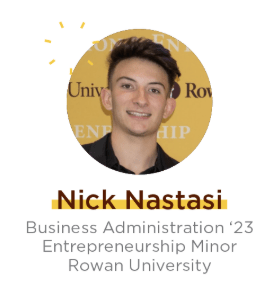
One Rowan entrepreneurship minor student shared:
“Taking the Entrepreneurship Minor at Rowan has increased my knowledge of how to start a company. The minor comes with education but also resources such as Studio 231, which has helped me prototype, and guest speaking events, which has given me the ability to hear from industry experts. Events like the Idea Challenge and Rohrer New Venture Competition have helped me with my business plan and provided funding as well. The entire RCIE staff are dedicated toward helping you inside and outside the classroom.”
MBA Concentration in Entrepreneurship
For students and professionals seeking advanced business knowledge, Rowan’s Master of Business Administration offers opportunities to build leadership, strategy and management expertise. An MBA Concentration in Entrepreneurship can be especially valuable for those who want to launch a venture, grow an existing business, lead innovation within an organization or strengthen their ability to evaluate business opportunities.
Graduate-level entrepreneurship coursework allows students to think more deeply about venture growth, competitive strategy, financial decision-making, innovation and leadership. For working professionals, founders and future business leaders, this type of advanced study can provide the tools needed to navigate complex business environments with greater confidence.
FAQ: Small Business Owner Skills and Entrepreneurship Education
What are the most important skills for small business owners?
The most important skills for small business owners include financial management, leadership, marketing, customer acquisition, operations, strategic planning, adaptability and problem-solving. These skills help entrepreneurs manage day-to-day responsibilities while planning for long-term growth.
Is an entrepreneurship degree worth it for small business owners?
An entrepreneurship degree can be worth it for small business owners who want structured training in finance, marketing, leadership, operations and venture development. While a degree is not required to own a business, it can help founders make stronger decisions, avoid common mistakes and build confidence as they grow.
What degree is best for starting a business?
Common degree options for starting a business include entrepreneurship, business administration, marketing, finance, management or an MBA. The best choice depends on the student’s goals, experience level and whether they want broad business training, specialized entrepreneurship education or advanced leadership development.
Do you need a degree to own a small business?
No, you do not need a degree to own a small business. However, business education can help entrepreneurs better understand finance, marketing, operations, leadership and strategy, which are all important for building a successful and sustainable business.
Why study entrepreneurship?
Studying entrepreneurship helps students learn how to identify opportunities, test ideas, solve problems, understand customers, manage resources and build ventures. These skills are valuable not only for future business owners but also for professionals who want to bring innovation and leadership into any career path.

Build the Skills to Start, Grow or Lead a Business
Small Business Month is a reminder that behind every successful venture is a foundation of knowledge, adaptability and continuous learning. From strategic decision-making and financial management to marketing, operations and leadership, the skills entrepreneurs need are developed through experience, education and practice.
At Rowan University, aspiring and current business owners can build those skills through hands-on programs designed for real-world impact. Whether you are refining a business idea, growing an existing venture or preparing to scale, Rowan provides opportunities to learn from experienced faculty, collaborate with peers and gain practical experience in entrepreneurship.
If you are ready to invest in your future and strengthen your path as an entrepreneur, explore Rowan University’s B.S. in Entrepreneurship, B.S. in Business Administration or Master of Business Administration.
About Rowan
A top 100 national public research institution, Rowan University offers bachelor’s through doctoral and professional programs in person and online to nearly 25,000 students. The fastest-growing public research institution in the Northeast and among the country’s top 10 fastest-growing, Rowan offers a thriving multidisciplinary environment with a strong emphasis on practical research in health care, engineering, science and business, while ensuring excellence in undergraduate education. Nationally recognized for innovation, high-quality, affordable education and public-private partnerships, Rowan is one of two universities in the U.S. to offer M.D., D.O. and D.V.M. degree programs.