

Leadership used to be easier to define.
Typically, the person with the most experience, strongest technical expertise or highest title naturally became the leader. But today’s workplace looks very different than it did even five years ago.
Artificial intelligence is changing workflows. Teams are increasingly hybrid, cross-functional and distributed. Employees expect more transparency, communication and flexibility from leadership. Organizations are also navigating new technologies, shifting expectations, tighter budgets and changing customer needs.
In 2026, successful leaders are no longer defined solely by authority or years of experience. They are defined by adaptability, strategic thinking, communication and the ability to help people move forward through change.
The need for adaptable leadership is not just a trend. The World Economic Forum’s Future of Jobs Report 2025 found that employers expect 39% of workers’ core skills to change by 2030, driven by shifts in technology, the economy and the way organizations work. That means the strongest leaders will be the ones who can keep learning, make thoughtful decisions and guide teams with clarity.
Across industries, employers are looking for professionals who can do exactly that.
Key Takeaways
- Leadership in 2026 is increasingly defined by adaptability, strategic thinking, communication and the ability to guide people through change.
- The World Economic Forum’s Future of Jobs Report 2025 found that employers expect 39% of workers’ core skills to change by 2030.
- Strong leaders need both business intelligence and people intelligence, including data literacy, emotional intelligence, ethics and collaboration.
- Leadership skills apply across industries, including business, engineering, healthcare, education, technology, public administration and nonprofit leadership.
- Flexible education can help students and working professionals build leadership skills while continuing to grow in their current fields.
Why Leadership Skills Matter More Than Ever
As professionals grow in their careers, technical expertise often becomes the foundation for something bigger: the ability to lead people, strategy and change.
Someone may be exceptional at marketing, engineering, healthcare, education, technology, operations or public service, but leadership requires a broader set of skills beyond performing individual tasks well.
Modern leaders are expected to:
- Make decisions in fast-changing environments
- Communicate across departments and teams
- Interpret data and use it strategically
- Manage organizational change
- Navigate conflict professionally
- Build trust among employees and stakeholders
- Balance business goals with human needs
At the same time, organizations are becoming more collaborative and less siloed. Leaders increasingly work across departments, locations and disciplines rather than operating within one isolated function.
The result is that leadership today requires both business intelligence and people intelligence. That combination is becoming one of the most valuable professional skill sets a person can develop.
The Essential Leadership Skills Professionals Need in 2026
While leadership styles continue to evolve, several essential leadership skills help professionals lead with more confidence, clarity and impact.
1. Strategic Decision-Making
Modern leadership often means making important decisions while navigating uncertainty, competing priorities and constant change. Strong strategic thinkers know how to connect the details in front of them to the bigger picture.
Strategic leaders are able to:
- Evaluate long-term consequences
- Connect day-to-day actions to larger goals
- Identify opportunities and risks early
- Prioritize effectively under pressure
- Adapt plans when circumstances shift
This matters because industries are evolving quickly. Leaders need the ability to think ahead, anticipate change and guide organizations through new challenges.
In many workplaces, strategic thinking is what helps someone move from being a strong contributor to being trusted with larger initiatives, teams and decisions.
2. Communication and Influence
Communication has always mattered in leadership, but its importance has grown as teams work across locations, platforms and departments.
Strong leaders know how to communicate with clarity and purpose. They can simplify complex ideas, align teams around shared goals and create transparency during periods of change.
Effective communication also involves:
- Active listening
- Reading team dynamics
- Responding thoughtfully under pressure
- Adjusting communication styles for different audiences
- Creating environments where employees feel heard
Leaders who communicate effectively are often better positioned to build trust, strengthen collaboration and move work forward. Communication is about helping people understand the goal, their role and the path ahead.
3. Adaptability and Change Management
One of the defining characteristics of today’s workforce is continuous change.
Organizations are adapting to new technologies, AI integration, economic shifts, evolving customer expectations and new workplace models. That is why adaptability has become one of the most valuable leadership traits in today’s workplace.
Adaptable leaders are able to:
- Stay steady under pressure
- Adjust strategies when needed
- Help teams navigate change
- Embrace innovation without losing focus
- Lead through transition with clarity
Adaptability does not mean reacting without direction. The strongest leaders maintain purpose while staying flexible enough to respond to new information, new tools and new expectations.
That ability to balance flexibility with stability is what allows organizations and teams to keep moving forward.
4. Data Literacy and Analytics
Data now influences nearly every major business decision.
Organizations track performance metrics, customer behavior, operational efficiency, market trends and financial outcomes at levels that continue to grow. But having access to information is not the same as knowing how to use it effectively.
Modern leaders increasingly need to:
- Interpret trends and insights
- Understand key business metrics
- Ask better strategic questions
- Use information to support decisions
- Translate data into action
This does not mean every leader needs to become a data scientist. It means leaders need enough data literacy to understand what information matters, what questions to ask and how data can support better decisions.
As AI and automation continue expanding, the ability to combine analytical thinking with human judgment is becoming even more valuable.
5. Collaboration and Team Leadership
Today’s organizations are more interconnected than ever before.
Projects often involve professionals from multiple departments, disciplines and locations working together at the same time. Because of this, leadership increasingly requires collaboration across functions rather than operating independently within one area.
Strong collaborative leaders are able to:
- Align diverse teams around shared goals
- Build relationships across departments
- Navigate differing perspectives
- Encourage productive teamwork
- Reduce organizational friction
This skill becomes especially valuable in complex organizations where success depends on communication and alignment between many moving parts.
Leaders who can unify teams and create momentum across departments are often among the most effective drivers of growth, innovation and trust.

6. Ethics and Accountability
Trust remains one of the most important foundations of leadership.
Employees, customers and organizations expect leaders to make decisions that are ethical, transparent and responsible. This is especially important during periods of change, when decisions may affect people, resources and long-term direction.
Leaders who demonstrate accountability:
- Take ownership of outcomes
- Communicate honestly
- Build credibility over time
- Create stronger organizational trust
- Foster healthier workplace cultures
The strongest leaders are not only focused on results. They are also focused on how those results are achieved.
Ethical leadership helps organizations make progress in ways that are responsible, sustainable and aligned with their values.
7. Emotional Intelligence
Technology may be transforming industries, but leadership is still fundamentally about people.
As workplaces become more digital, human-centered leadership skills are becoming even more important. Employees increasingly value leaders who can build trust, listen carefully, navigate conflict and support a healthy team culture.
Emotional intelligence helps leaders understand how their communication, decisions and behavior affect others.
Leaders with strong emotional intelligence are often better equipped to:
- Manage difficult conversations
- Strengthen collaboration
- Support team well-being
- Build inclusive environments
- Lead teams through stressful periods
Many organizations are recognizing that technical expertise alone does not create strong leadership if communication, empathy and emotional awareness are missing. The ability to understand people remains one of the most important parts of leading well.
8. Continuous Learning
The most successful leaders are always evolving.
Staying curious, adapting to new trends and committing to ongoing development are what help leaders remain relevant in a changing world.
Continuous learners are more likely to:
- Stay current with industry changes
- Explore new tools and technologies
- Seek feedback
- Learn from challenges
- Apply new ideas to real problems
This mindset matters because the workplace will continue to change. Leaders who stay open to growth are better prepared to guide others through that change.

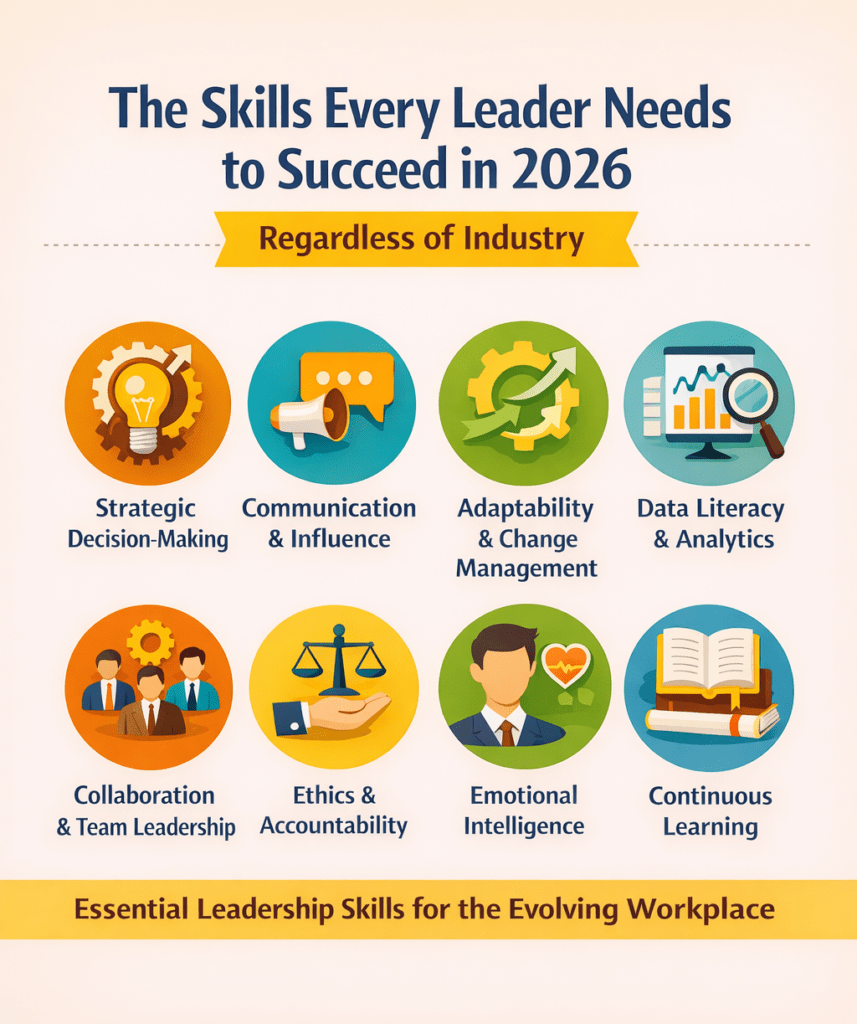
8 Leadership Skills for 2026 at a Glance
Here’s a quick recap of the essential leadership skills professionals can build to lead with more confidence, clarity and impact in 2026 and beyond.
Why Leadership Skills Apply Across Every Industry
One reason leadership development remains so valuable is because these skills transfer across industries and career paths.
Whether someone works in:
- Business
- Engineering
- Healthcare
- Education
- Technology
- Public administration
- Nonprofit leadership
The core leadership challenges are often similar. Organizations across industries need professionals who can solve problems strategically, communicate effectively, lead teams through change, manage complexity, build trust and drive collaboration.
That versatility is what makes leadership skills a powerful long-term investment for career growth. A professional may change roles, employers or industries, but strong leadership skills can continue moving with them.
AI Is Raising the Bar for Leadership
Artificial intelligence is not replacing leadership. It is raising the standard for it.
As organizations generate more data and adopt new technologies, leaders are needed to help translate information into strategy, guide teams through transformation and make thoughtful decisions in evolving environments.
In many organizations, the biggest opportunity is not simply adopting new tools. It is developing leaders who can help people use those tools responsibly, creatively and effectively.
The leaders who stand out in 2026 will be the ones who can combine technology with judgment, innovation with ethics and efficiency with human understanding.
Who Benefits Most From Developing Leadership Skills?
Leadership development can be valuable at many stages of a career. It becomes especially impactful for professionals who are preparing to take on greater responsibility or expand their influence.
Leadership skills may be especially useful if you:
- Are moving into a management role
- Are a manager, supervisor or team lead who wants to strengthen leadership skills for career growth
- Want greater influence within your organization
- Are transitioning into strategy-focused work
- Lead projects, teams or initiatives
- Work across departments or disciplines
- Are preparing for long-term career growth
- Want to build confidence as a decision-maker
In many cases, leadership skills are what help turn experience into advancement.
How Professionals Build Leadership Skills
Leadership skills rarely develop overnight. Most professionals build them gradually through experience, reflection, mentorship and intentional learning.
Professionals often strengthen leadership through:
- Workplace experience
- Mentorship
- Team collaboration
- Professional development
- Project leadership
- Feedback from supervisors and peers
- Structured education
For many working professionals, formal education can help accelerate leadership growth by connecting practical experience with broader strategy, organizational thinking and leadership frameworks.
This can be especially valuable for professionals preparing for management roles, career advancement, industry transitions, executive leadership opportunities or greater organizational influence.
Developing leadership intentionally can help professionals move from being technically skilled to being trusted to guide larger initiatives, teams and decisions.
How Flexible Education Helps Professionals Build Leadership Skills
For professionals balancing career growth with work and personal responsibilities, flexibility matters.
Rowan University offers undergraduate and graduate programs designed to support leadership development across industries, including business, engineering management, healthcare, education and school leadership.
Through flexible online and hybrid learning formats, students can continue working while building career-relevant skills in leadership, communication, strategic decision-making, collaboration, problem-solving and organizational change.
Rowan’s leadership-focused programs connect academic learning with practical application, helping students and working professionals strengthen the leadership skills they need to lead with confidence in their chosen fields.
Frequently Asked Questions About Leadership Skills in 2026
What are the most important leadership skills in 2026?
Some of the most important leadership skills in 2026 include strategic decision-making, communication, adaptability, data literacy, collaboration, ethics, emotional intelligence and continuous learning.
Why are leadership skills important across industries?
Leadership skills are valuable across industries because many organizations need professionals who can solve problems, communicate clearly, manage change, build trust and guide teams toward shared goals.
How is AI changing leadership?
AI is changing leadership by increasing the need for data-informed decision-making, ethical judgment, digital fluency and the ability to help teams adapt to new tools and workflows.
How can professionals build stronger leadership skills?
Professionals can build leadership skills through workplace experience, mentorship, project leadership, feedback, professional development and structured education.
Build Leadership Skills for 2026 and Beyond
The workplace is evolving quickly, and leadership is evolving with it.
The professionals who continue growing will be the ones who can adapt, communicate clearly, think strategically and guide others through change.
Leadership today is not only about managing operations. It is about helping organizations and people move forward in environments that continue to shift.
At Rowan University, students can explore flexible programs designed to help them build leadership skills for the future of work, including:
- Bachelor of Science in Business Administration (BSBA)
- Bachelor of Science in Healthcare Management and Administration
- Master of Business Administration (MBA)
- Master of Engineering Management
- Master of Arts in School Administration
- Master of Education in Teacher Leadership
No matter where you are in your leadership journey, the right education can help you strengthen the skills, confidence and perspective needed to move forward.
About Rowan
A top 100 national public research institution, Rowan University offers bachelor’s through doctoral and professional programs in person and online to nearly 25,000 students. The fastest-growing public research institution in the Northeast and among the country’s top 10 fastest-growing, Rowan offers a thriving multidisciplinary environment with a strong emphasis on practical research in health care, engineering, science and business, while ensuring excellence in undergraduate education. Nationally recognized for innovation, high-quality, affordable education and public-private partnerships, Rowan is one of two universities in the U.S. to offer M.D., D.O. and D.V.M. degree programs.